← Compatibility Index
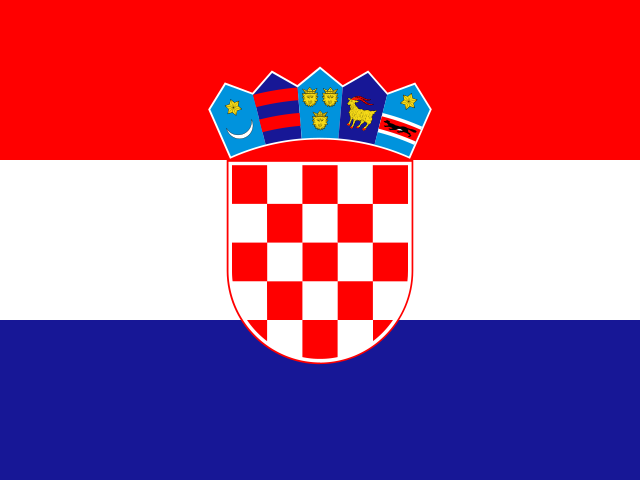 Croatia
Ranked against every country we've compared Croatia to, highest compatibility first.
Qatar34/100
“Two countries united by genuine hospitality and divided by absolutely everything else about how it is delivered, received, and priced.”
Breakdown & sources
Work-Life Balance30
Croatia's hosts have day jobs and enforce quiet hours; Qatar's lobbies operate at cathedral scale around the clock — one culture treats rest as sacred, the other has simply outsourced it to staff.
Hierarchy & Formality25
In Croatia, the grandmother inspects your suitcase and you answer to her; in Qatar, a man in a white thobe carries your bag without being asked — authority flows in opposite directions and neither party would find the other's arrangement entirely legible.
Communication Style40
Both cultures reward warmth over efficiency, but Croatia expresses it through mild suspicion and unsolicited local knowledge, while Qatar expresses it through a welcome ritual that must not, under any circumstances, be rushed.
Punctuality Culture45
Neither country appears to be in a particular hurry — Croatia because the host might be at work, Qatar because the dates and coffee ceremony has its own unhurried timetable — making this the dimension least likely to cause a diplomatic incident.
Social Bonding32
Croatia bonds through temporary adoption into a household complete with fig jam and thin stone walls; Qatar bonds through spectacle and deference — one wants you to feel like family, the other like royalty, and the two roles are not interchangeable at dinner.
Japan34/100
“Two cultures that have both mastered the art of patient silence in the face of a confused foreigner, but for entirely different reasons and with entirely different expectations of what happens next.”
Breakdown & sources
Work-Life Balance38
Croatia treats the afternoon as a philosophical commitment to rest; Japan treats it as an opportunity to remain at one's desk demonstrating loyalty to the concept of work itself.
Hierarchy & Formality28
Croatia will address you by your first name before your coffee arrives; Japan would like to establish your professional title, company affiliation, and seniority before deciding how deeply to bow.
Communication Style30
Croatia meets you halfway without being asked and considers the matter settled; Japan rewards effort with extraordinary grace while remaining, as the article diplomatically puts it, politely unmoved by its absence.
Punctuality Culture42
Japan's trains run on a precision that borders on moral philosophy, while Croatia's relationship with stated start times is best understood as a friendly opening negotiation.
Social Bonding35
Croatia bonds over wine on a terrace with strangers who become friends within the hour; Japan bonds over years of careful, earned trust that one does not rush without consequence.