← Compatibility Index
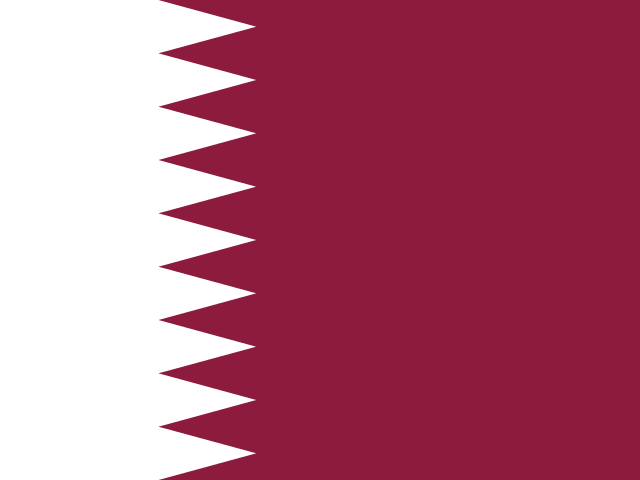 Qatar
Qatar
Ranked against every country we've compared Qatar to, highest compatibility first.
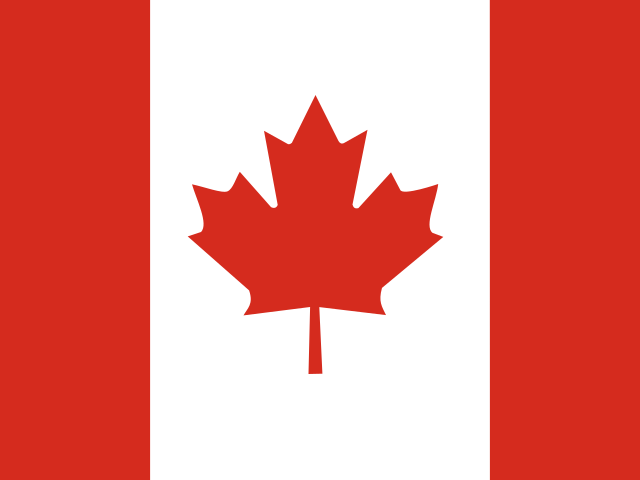
Canada54/100
“Two nations united by a shared refusal to go outside, divided by everything that happens once they're in.”
Breakdown & sources
Work-Life Balance50
Both cultures have perfected the art of the climate-controlled indoor existence, though one does it with hockey leagues and one does it with mall fountains the size of municipal parks.
Hierarchy & Formality45
Canada's studied informality and Qatar's structurally layered formality occupy the same building but take very different elevators.
Communication Style52
Canadian apologetic indirectness and Qatari diplomatic indirectness arrive at the same destination by roads that would confuse each other's GPS.
Punctuality Culture55
When outdoor temperatures are either lethal or merely homicidal, 'I'll be there in ten minutes' becomes a philosophical statement in both countries.
Social Bonding68
Shared suffering — whether minus thirty-five or plus fifty — turns out to be an unexpectedly reliable foundation for human warmth, even when the weather itself refuses to cooperate.

Poland38/100
“Poland and Qatar are two countries that have both decided healthcare tells you everything you need to know about a culture — one treats it as a luxury amenity, the other as a public endurance sport — and the rest of their compatibility follows accordingly.”
Breakdown & sources
Work-Life Balance35
Qatar's employer-sponsored everything model and Poland's state-subsidised stoicism represent two entirely different philosophies on who owes whom what outside working hours.
Hierarchy & Formality40
Qatar's deference runs through employer-sponsor relationships and institutional polish, while Poland's runs through grey waiting rooms and queue number tickers — different architectures of submission, equally immovable.
Communication Style42
Qataris navigating a multilingual expat services culture and Poles who've never guaranteed English at a public counter are both, in their own way, asking you to do a little more homework before you arrive.
Punctuality Culture30
In Qatar, a specialist sees you within the hour; in Poland, 'next available' is a concept flexible enough to encompass entire seasons — the two countries do not share a definition of the word 'soon.'
Social Bonding43
Poland bonds over shared suffering — snacks in the NFZ waiting room, dark humour about the system — while Qatar bonds over shared amenity, which is a perfectly pleasant way to never quite get close to anyone.
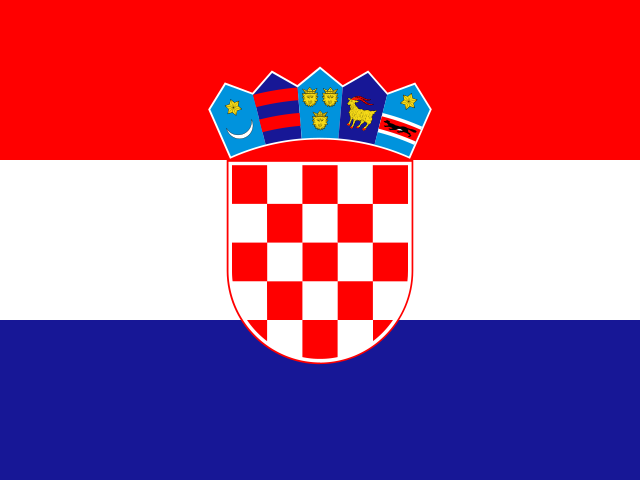
Croatia34/100
“Two countries united by genuine hospitality and divided by absolutely everything else about how it is delivered, received, and priced.”
Breakdown & sources
Work-Life Balance30
Croatia's hosts have day jobs and enforce quiet hours; Qatar's lobbies operate at cathedral scale around the clock — one culture treats rest as sacred, the other has simply outsourced it to staff.
Hierarchy & Formality25
In Croatia, the grandmother inspects your suitcase and you answer to her; in Qatar, a man in a white thobe carries your bag without being asked — authority flows in opposite directions and neither party would find the other's arrangement entirely legible.
Communication Style40
Both cultures reward warmth over efficiency, but Croatia expresses it through mild suspicion and unsolicited local knowledge, while Qatar expresses it through a welcome ritual that must not, under any circumstances, be rushed.
Punctuality Culture45
Neither country appears to be in a particular hurry — Croatia because the host might be at work, Qatar because the dates and coffee ceremony has its own unhurried timetable — making this the dimension least likely to cause a diplomatic incident.
Social Bonding32
Croatia bonds through temporary adoption into a household complete with fig jam and thin stone walls; Qatar bonds through spectacle and deference — one wants you to feel like family, the other like royalty, and the two roles are not interchangeable at dinner.
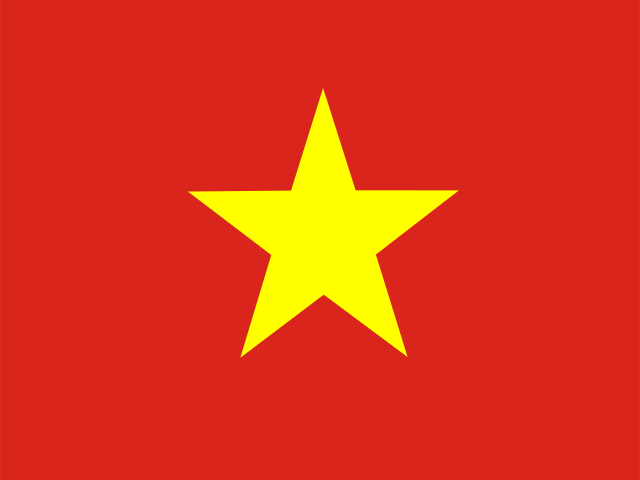
Vietnam34/100
“Two nations united by a love of commerce and divided by everything else about it — one treats a price tag as an invitation to debate, the other treats it as a fact of nature enforced by marble flooring and 18-degree ambient cooling.”
Breakdown & sources
Work-Life Balance40
The articles don't dwell on office hours, but a culture that turns grocery shopping into an endurance sport and one that builds indoor ski slopes to avoid going outside are probably not optimising for the same definition of 'rest.'
Hierarchy & Formality38
Qatar's mall culture implies a certain ordained order — fixed prices, modest dress, polite confused stares — while Vietnam's markets run on a cheerful, grandmother-enforced chaos that respects no authority except a better counteroffer.
Communication Style28
Vietnam communicates through theatre, misdirection, and the strategic deployment of apparent disinterest; Qatar communicates through a politely immovable price tag, which is less a conversation and more a closing statement.
Punctuality Culture48
Neither country's shopping culture suggests an obsession with the clock — Ramadan malls run on iftar time and Vietnamese wet markets reward the early riser — so there may be a grudging, accidental alignment here, even if it means nothing.
Social Bonding42
Both cultures treat commerce as a social occasion rather than a mere errand, which is the one narrow corridor of compatibility before you remember that one bonds over haggling and the other over gondola rides past a Zara.