← Compatibility Index
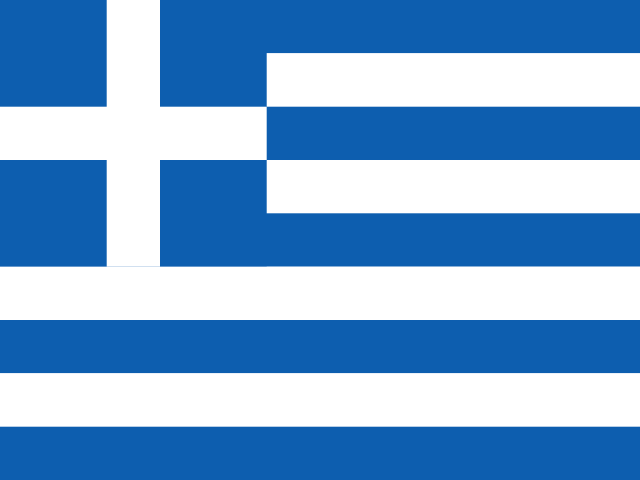 Greece
Ranked against every country we've compared Greece to, highest compatibility first.
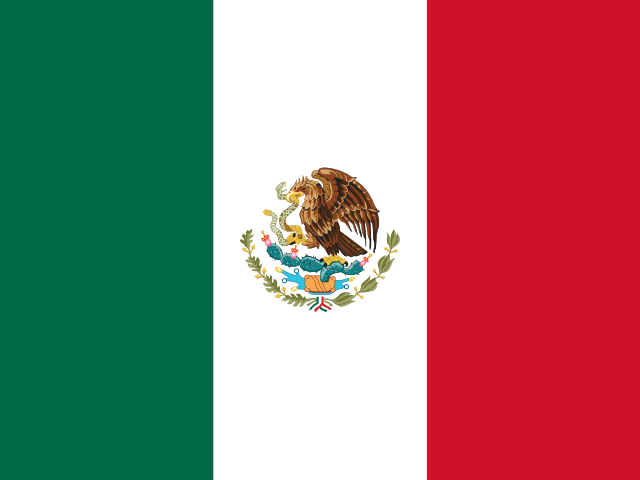
Mexico72/100
“Two countries that both treat dating as a team sport, differing mainly in whether the coach is a yiayia with a sharp eye or a WhatsApp group of cousins you've never met.”
Breakdown & sources
Work-Life Balance68
Both cultures prioritise life over work in principle, though the specific life in question is almost entirely family obligations.
Hierarchy & Formality70
Parental authority operates as an informal but binding governance structure in both countries, differing mainly in whether it is expressed through direct interrogation or a coordinated group chat.
Communication Style75
Loud, animated, and deeply personal by default — the main difference is whether a heated dinner table debate counts as affection, which in both cases it does.
Punctuality Culture65
Neither culture treats the stated start time of a family gathering as a serious commitment, which is one of the few scheduling philosophies that translates without friction.
Social Bonding80
Both countries bond through collective ritual — the Sunday lunch, the quinceañera, the cousin vetting process — making newcomers feel simultaneously welcomed and quietly assessed.
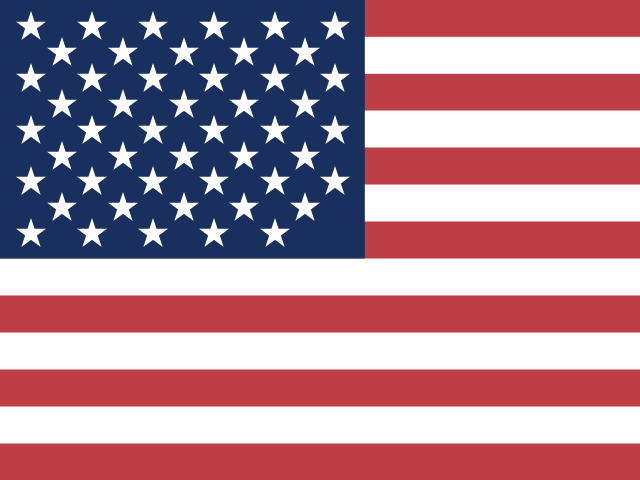
USA52/100
“Two nations that both believe deeply in community, separated by the unbridgeable gulf between actually sharing your dinner and warmly gesturing at someone who has your dinner.”
Breakdown & sources
Work-Life Balance50
The articles do not address working hours directly, leaving both countries diplomatically unscored — a compatibility the editors note is itself suspiciously compatible.
Hierarchy & Formality55
Neither culture is described as rigidly hierarchical in daily neighbourhood life, though Greece enforces communal authority over parking disputes with a tenacity most governments would envy.
Communication Style40
Greece regards the first three minutes of American neighbourly warmth as a promising opening to a lifelong relationship; America regards it as the entirety of one.
Punctuality Culture55
The articles are silent on punctuality, which, given Greece's reputation and America's regional variation, may be the most tactful editorial decision this publication has ever made.
Social Bonding38
Greeks bond by involving themselves irreversibly in your life; Americans bond by joining a Facebook group about it — both sincere, separated only by the question of whether you will be fed.
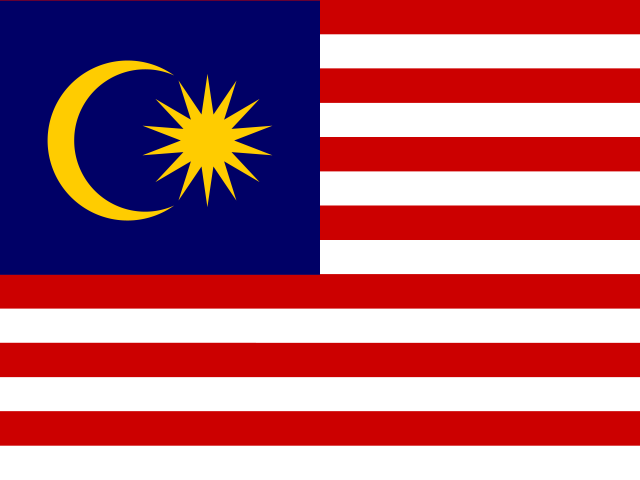
Malaysia52/100
“Two cultures that both believe relationships matter more than systems, separated chiefly by whether the system in question was designed by someone who wanted it to function.”
Breakdown & sources
Work-Life Balance58
Greece treats the afternoon as a philosophical position; Malaysia treats it as a scheduling opportunity — different methods, a shared suspicion of the person still at their desk at 7pm.
Hierarchy & Formality55
Both countries maintain hierarchies with quiet conviction, though Malaysia's tends to produce functioning appointment systems while Greece's produces clerks personally offended by your paperwork.
Communication Style50
Greeks deliver bad news directly and with feeling; Malaysians deliver it indirectly and with a smile — both parties will leave the conversation having technically communicated nothing actionable.
Punctuality Culture45
Malaysia books appointments; Greece forms queues before the office opens in the hope that enthusiasm might substitute for a functioning system — close, but not quite the same religion.
Social Bonding62
Hospitality is a competitive sport in both countries, and a foreigner who accepts a second helping in either Athens or Kuala Lumpur will find themselves committed to a friendship whether they planned to or not.
Canada48/100
“Two nations united by a superficial politeness and divided by everything underneath it — one builds relationships through grandmothers, the other through geolocation.”
Breakdown & sources
Work-Life Balance45
Greece embeds life so thoroughly into social and family time that 'work-life balance' reads as a foreign concept, while Canada optimises its personal life around commute logistics — different dysfunctions, equal incomprehension of each other's.
Hierarchy & Formality52
Greece defers instinctively to family elders and the opinionated grandmother constitutes her own tier of authority; Canada, by contrast, maintains hierarchy through passive scheduling rather than anyone ever openly admitting it exists.
Communication Style32
Greek relatives will ask about your intentions, your income, and your mother's opinion before the entrées arrive; Canadians will signal the same interest with a friendliness so uniformly calibrated it is functionally indistinguishable from polite indifference.
Punctuality Culture55
Greece runs on a social timeline where things happen when the family is assembled and the mood is right; Canada runs on a calendar invite that accounts for forty minutes of transit — both, in fairness, will leave you waiting.
Social Bonding38
In Greece you are bonded to an entire extended family before you have finished your first meal; in Canada you may match, meet, and mutually ghost three times before anyone concedes that bonding has technically commenced.
South Korea34/100
“Greece and South Korea have each perfected the art of making strangers feel welcome — one through unsolicited adoption, the other through silent, flawless systems — and have absolutely nothing else in common.”
Breakdown & sources
Work-Life Balance38
Greece treats the coffee break as a constitutional right and the August holiday as a sacred rite; South Korea treats both as evidence of insufficient commitment.
Hierarchy & Formality28
Korean staff deliver excellence in respectful silence while Greek grandmothers interrogate your marital status before you've found the lift — both hierarchical, but one is Confucian and the other is simply matriarchal.
Communication Style22
Greece communicates everything immediately, emotionally, and with olive oil; South Korea communicates through precision, restraint, and the implicit understanding that excellence requires no explanation.
Punctuality Culture25
A country where check-in begins with 'sit, have a coffee, relax' and one where room technology is optimised to the minute are not, technically, operating in the same dimension of time.
Social Bonding48
Both cultures bond with strangers through hospitality rituals — raki and parting gifts of olive oil on one side, communal jjimjilbang pyjamas and BBQ terraces on the other — which is a remarkable convergence that stops precisely there.
Singapore31/100
“Two countries that both have parks, in the same way that two people both have opinions — the similarity ends approximately there.”
Breakdown & sources
Work-Life Balance35
Greece treats leisure as a birthright and infrastructure as optional; Singapore treats infrastructure as a birthright and leisure as something to be optimised with an app.
Hierarchy & Formality28
Singapore's bureaucratic willpower built a garden-city from scratch; Greece's bureaucratic output appears to be, at best, inconsistent public fountains.
Communication Style40
Athens communicates its public spaces through benign neglect and stray cats; Singapore communicates its expectations through laminated signage and enforceable fines.
Punctuality Culture25
One culture built a park connector network on a timeline; the other has been meaning to water the neighbourhood park since roughly 2007.
Social Bonding38
Greeks bond organically in dusty squares with stray cats as witnesses; Singaporeans bond on NParks-approved connector routes with hydration plans and no littering.
Japan28/100
“Two nations that both love a festival, provided one of them is allowed to schedule it three weeks in advance and the other is allowed to start it whenever the lamb is ready.”
Breakdown & sources
Work-Life Balance22
Japan treats leisure as a second job requiring advance booking; Greece treats the concept of a schedule as a light suggestion that dissolves pleasantly after the second raki.
Hierarchy & Formality35
Japan's collective orderliness is so precisely maintained that crowds are quietly guided without noticing, while Greece's village elder simply hands you a drink you cannot refuse and considers the matter settled.
Communication Style20
Japan communicates through careful research, advance notice, and gentle volunteer direction; Greece communicates through the word 'tha doume,' which means everything and commits to nothing.
Punctuality Culture15
One country lines up twenty minutes early for an 11:00 museum slot; the other advises you not to arrive at the stated time lest you find yourself alone with somebody's grandmother.
Social Bonding48
Both cultures bond with impressive sincerity over food, dance, and communal celebration — they simply disagree, fundamentally and irreconcilably, on whether any of it should have been planned.