← Compatibility Index
 Mexico
Ranked against every country we've compared Mexico to, highest compatibility first.
Greece72/100
“Two countries that both treat dating as a team sport, differing mainly in whether the coach is a yiayia with a sharp eye or a WhatsApp group of cousins you've never met.”
Breakdown & sources
Work-Life Balance68
Both cultures prioritise life over work in principle, though the specific life in question is almost entirely family obligations.
Hierarchy & Formality70
Parental authority operates as an informal but binding governance structure in both countries, differing mainly in whether it is expressed through direct interrogation or a coordinated group chat.
Communication Style75
Loud, animated, and deeply personal by default — the main difference is whether a heated dinner table debate counts as affection, which in both cases it does.
Punctuality Culture65
Neither culture treats the stated start time of a family gathering as a serious commitment, which is one of the few scheduling philosophies that translates without friction.
Social Bonding80
Both countries bond through collective ritual — the Sunday lunch, the quinceañera, the cousin vetting process — making newcomers feel simultaneously welcomed and quietly assessed.

Ireland68/100
“Two nations that have independently concluded life is too short to be sober at a funeral, separated chiefly by their attitude toward what time the party is supposed to start.”
Breakdown & sources
Work-Life Balance72
Mexico schedules entire months as officially unavailable for commerce, while Ireland invented a national holiday the Irish themselves were too holy to enjoy — both, in their way, have made peace with the idea that work is the interruption.
Hierarchy & Formality61
Mexico's festival calendar answers to saints, virgins, and the revolution; Ireland's answers to the parish and the publican — neither country is exactly flat, but neither expects you to book a meeting with the Virgin of Guadalupe two weeks in advance.
Communication Style74
Both cultures have mastered the art of the correction that doesn't feel like a correction — the Mexican who patiently dismantles your Halloween analogy and the Irishman who watches Chicago dye its river green without saying a word are operating from the same emotional frequency.
Punctuality Culture55
Mexico has formally enshrined lateness by advising visitors that any event ending in '-ada' arrives when it arrives; Ireland, having spent most of its national holiday at mass, at least has a theological excuse for the delay.
Social Bonding81
One country invites its dead to dinner and calls it a party; the other turned a quiet religious observance into the world's most franchised pub crawl — as frameworks for human togetherness go, both are doing considerably more than the minimum.
Vietnam62/100
“Two countries that will both feed you magnificently and judge you quietly for doing it wrong, united by street-level density and separated by whether warmth is offered immediately or invoiced after a suitable probationary period.”
Breakdown & sources
Work-Life Balance63
Both cultures subordinate the individual to the communal rhythm — Mexico via the non-negotiable fiesta calendar, Vietnam via the 6am wet market alarm — leaving little room for the freelancer's dream of sleeping in.
Hierarchy & Formality58
Vietnam earns trust through patient repetition and tonal respect; Mexico through cheerful first-name familiarity within the week — compatible destinations, wildly incompatible onboarding processes.
Communication Style55
Mexico announces itself loudly and expects you to join the conversation immediately; Vietnam watches from the alley until you've demonstrated sufficient loyalty to your regular pho vendor.
Punctuality Culture67
Neither culture worships the clock, but Vietnam's wet market operates on a ruthless 6am deadline while Mexico's tianguis simply vanishes by evening — different anxieties, equally inconvenient if ignored.
Social Bonding64
Both cultures build community at street level through food, repetition, and a shared conviction that closed doors and unfriendliness are entirely different things — they simply disagree on how long the door should stay closed first.
South Korea48/100
“Two nations that both love a Sunday in the park, separated by the philosophical chasm between 'bring the whole family and see what happens' and 'pin your GPS coordinates so the chicken arrives on time.'”
Breakdown & sources
Work-Life Balance45
Mexico dissolves the boundary between leisure and living room; South Korea optimizes leisure with the same energy it brings to the office — both are committed, just to entirely different gods.
Hierarchy & Formality50
One culture brings grandma to the park as a matter of filial devotion; the other reserves cherry blossom spots with military seriousness — respect for order runs deep in both, expressed through wholly incompatible rituals.
Communication Style42
Mexico communicates via ambient noise, shared vendors, and the general understanding that a park is not a library; South Korea communicates via app, GPS pin, and a delivery rider who requires coordinates, not vibes.
Punctuality Culture38
A culture that considers Sunday's start time a loose suggestion meets one that tracks its picnic delivery to the meter — a pairing that will spend considerable time waiting for each other, and disagreeing about who is late.
Social Bonding62
Both countries have independently concluded that socialization requires food, outdoor space, and a complete disregard for quiet hours — which is, admittedly, a stronger foundation than most diplomatic treaties.
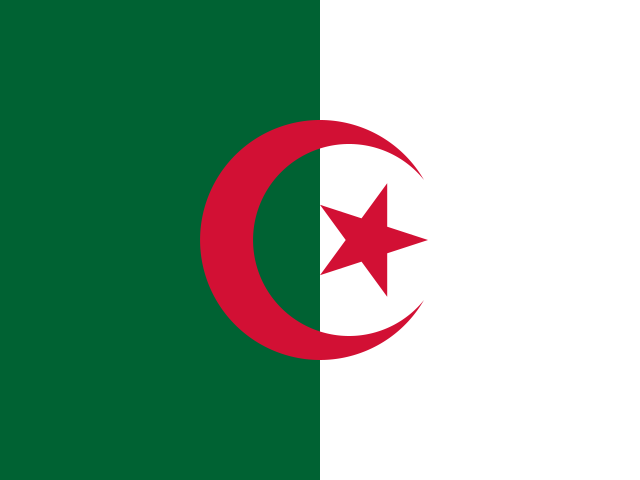
Algeria38/100
“A culture that treats composure as social currency meets one that considers stillness a mild personal insult — both warm, both hospitable, both completely baffled by the other's default volume setting.”
Breakdown & sources
Work-Life Balance50
The articles don't venture into the office, leaving this dimension balanced on the reasonable assumption that two countries with strong family-first values can at least agree the weekend exists.
Hierarchy & Formality45
Algeria's public propriety suggests a respect for social order that Mexico shares in greeting rituals, though Mexico's insistence on individually hugging every person in the room suggests a rather more egalitarian interpretation of formality.
Communication Style22
Algeria rewards controlled volume and restraint as marks of character; Mexico treats animated, loud conversation as the conversational baseline — these are not merely different preferences but opposing definitions of what a functioning human sounds like.
Punctuality Culture42
Algeria's articles offer no particular punctuality sins to confess, while Mexico's 'ahorita' is described, with admirable frankness, as a philosophy rather than a time — a gap that is either charming or maddening depending entirely on which side of the appointment you are standing on.
Social Bonding30
Being hugged by a stranger's extended family within ten minutes is the Mexican warm welcome; being watched with quiet, watchful propriety is the Algerian one — both are genuinely hospitable, and both will completely unnerve the other country's nationals.
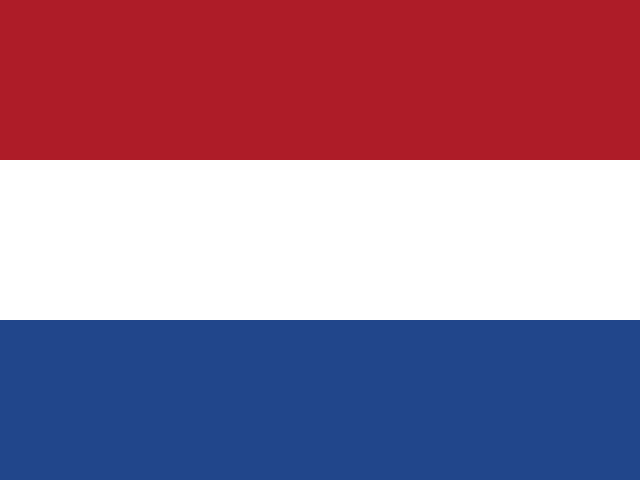
Netherlands38/100
“One country decorates altars for its beloved dead with marigolds and devotion; the other decorates itself in orange and haggles over used appliances — a pairing that suggests compatible enthusiasm for spectacle, and almost nothing else.”
Breakdown & sources
Work-Life Balance45
Mexico folds grief, memory, and family ritual into national life with baroque tenderness; the Netherlands does the same with efficiency and a secondhand toaster, which is either a different philosophy or the same one expressed in a colder climate.
Hierarchy & Formality30
Mexico's Día de los Muertos treats the dead as honoured guests requiring precise, personal ceremony; the Dutch treat their monarch as a useful excuse to day-drink in the street, suggesting a rather different relationship with authority and reverence.
Communication Style35
Mexico communicates loss through colour, marigolds, and symbolic ofrendas layered with specific meaning; the Netherlands communicates joy by wearing one colour and haggling loudly, which is technically also layered with meaning, just less of it.
Punctuality Culture42
Mexico's vigils run across two designated nights governed by tradition and regional variation; the Dutch schedule their annual personality glitch to a single date and are extremely put out when the trams don't cooperate — one culture bends time, the other files a complaint about it.
Social Bonding40
Both nations bond most intensely through their signature annual holiday — one by welcoming strangers into cemeteries to meet their dead, the other by selling them a used blender, which are two genuinely touching gestures that will never quite translate to each other.
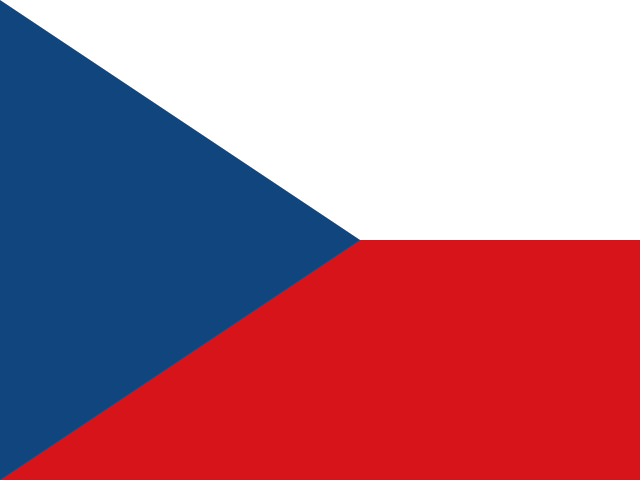
Czech Republic38/100
“Two nations united by excellent food and divided by everything that happens before, during, and after eating it.”
Breakdown & sources
Work-Life Balance45
Both cultures value life outside the office, though Czechs express this by going home efficiently and Mexicans by making the errand itself a social occasion that lasts two hours.
Hierarchy & Formality42
Czech formality is the cold, structural kind — nobody tells you the rules, you simply feel the silent disapproval when you break them — while Mexican formality is warmer but no less real, built on greetings, relationships, and the cardinal sin of skipping 'buenos días'.
Communication Style18
The Czech cashier who has not spoken a full sentence since Tuesday and the Mexican market vendor who will not let you leave without a conversation about your avocado are, communicatively speaking, from different planets.
Punctuality Culture44
Czechs treat dawdling at the till as a minor social crime; Mexicans treat the market interaction itself as an event with no fixed end time — a philosophical difference that extends well beyond grocery shopping.
Social Bonding22
Mexico builds loyalty through repeated visits, remembered names, and an improved avocado selection; Czech Republic builds it through the shared, wordless understanding that nobody here wants to talk about it.
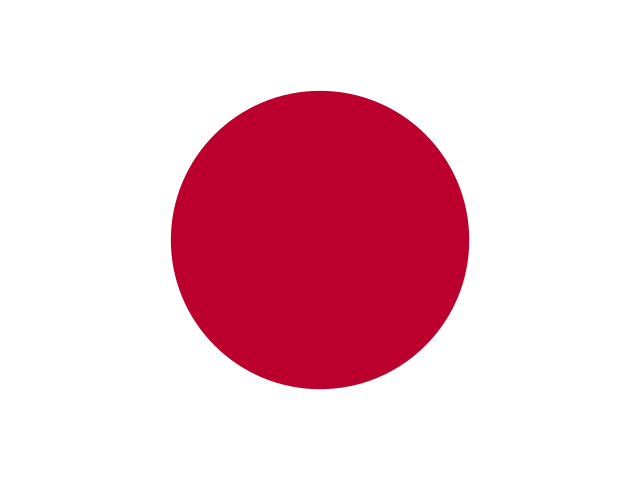
Japan34/100
“A kokuhaku-less courtship between a country that sequences its emotions like kaiseki courses and one that has already introduced you to its mother: technically possible, spiritually exhausting.”
Breakdown & sources
Work-Life Balance38
Japan treats the forty-five-minute ramen queue as a form of devotion; Mexico treats the 11pm street taco as proof that life begins after hours — both are serious about the ritual, but only one of them would call it leisure.
Hierarchy & Formality28
Japan requires a signed emotional contract before a relationship officially begins; Mexico has already seated you next to the grandmother before anyone thought to ask your surname.
Communication Style22
One culture under-declares everything and considers sustained ambiguity a form of art; the other makes declarations in the town square with a live band — the gap between them is not a misunderstanding, it is a philosophy.
Punctuality Culture45
Japan queues in the rain for forty-five minutes with quiet conviction; Mexico's best taco cart appears at 11pm on a schedule known only to regulars — both are punctual, just not to the same clock.
Social Bonding30
In Japan you earn the group introduction across several carefully sequenced meetings; in Mexico the group introduction is the first meeting, and the vetting happened while you were still finding parking.
Out of Office: One Country Treats Dinner Like a Sacred Ritual. The Other Treats It Like One. They Are Not Talking About the Same Religion.Out of Office: In Japan You Must Formally Apply for a Relationship. In Mexico You're Already In One and Nobody Told You.Out of Office: One Country Treats Dinner Like a Sacred Ritual. The Other Treats It Like One. They Are Not Talking About the Same Religion.

Germany34/100
“Two nations united only by the existence of supermarkets, which they have managed to make into entirely opposite philosophical statements.”
Breakdown & sources
Work-Life Balance38
Germany treats leisure as a scheduled civic right (closed Sundays, by law); Mexico treats commerce as a social occasion — compatible in outcome, utterly incompatible in reasoning.
Hierarchy & Formality42
Both cultures observe their rituals with great seriousness — one bows to the efficiency of the belt, the other to the courtesy of the greeting — but they would find each other's rituals baffling.
Communication Style18
Germany has declared the supermarket checkout a silence-mandatory zone; Mexico has declared that a transaction without conversation is 'vaguely rude' — this is not a minor stylistic difference, it is a civilisational schism.
Punctuality Culture22
The German checkout belt does not stop for human frailty; the Mexican market vendor will personally select your mangoes by planned consumption date — one culture is racing the clock, the other has not yet acknowledged the clock's authority.
Social Bonding30
Germans bond through shared pragmatic suffering (correct layering, Pfand solidarity, trolley token stewardship); Mexicans bond through unhurried generosity and a sample slice of fruit — warmth is present in both cases, expressed in ways that would mutually confuse.
Norway34/100
“Two nations who have looked at the concept of 'a nice time' and arrived at conclusions so opposite that one suspects they have never once consulted a map of the same planet.”
Breakdown & sources
Work-Life Balance38
Mexico sends a man with a frozen drink to your deckchair; Norway sends you to an outhouse in February and calls it restorative — both are sincere, which is somehow the most alarming part.
Hierarchy & Formality42
Mexico greets you as 'amigo' and means it warmly; Norway greets you with a DNT logbook and means it structurally — intimacy and distance, each with impeccable internal logic.
Communication Style30
One culture deploys attentive warmth as a default frequency; the other considers ringing reception twice in one evening a documented social incident.
Punctuality Culture45
Mexico rewards the organised resort-goer who books at dawn, while Norway enforces the honour system with a seriousness that suggests the hytte cabin log is a binding legal instrument.
Social Bonding22
An invitation to a Norwegian hytte is the highest honour the country grants, which is deeply moving right up until you realise it involves splitting logs in silence forty kilometres from a bar.
Sweden34/100
“A country that queues by asking strangers for help meets a country that invented a machine specifically to avoid asking strangers for anything — compatibility, like the queue itself, is largely theoretical.”
Breakdown & sources
Work-Life Balance40
Mexico bends time around relationships and celebration; Sweden bends time around the system — both outcomes look like balance, but the underlying physics are irreconcilable.
Hierarchy & Formality38
Sweden's unwritten rules are enforced through collective silence and pointed non-eye-contact; Mexico's unwritten rules are enforced through eleven strangers collectively remembering your name — both rigorous, neither legible to the other.
Communication Style22
One culture considers shouting a question across a crowd to be a perfectly reasonable social tool; the other has literally automated away the need to say a single word in public.
Punctuality Culture30
Sweden's numbered-ticket system implies that time itself has a correct order; Mexico's cloud-queue implies that time is a rough consensus — a gap wide enough to lose a philosophy department in.
Social Bonding28
Mexicans bond by folding strangers into a living, breathing social contract; Swedes bond by respecting the profound personal dignity of never requiring that of anyone.

Estonia31/100
“Two nations that have independently optimised for opposite definitions of a good life, and would each find the other's solution quietly alarming.”
Breakdown & sources
Work-Life Balance38
Mexico embeds leisure into every transaction including buying tomatoes, while Estonia has automated transactions precisely so that no leisure need be embedded in them.
Hierarchy & Formality42
Mexico's formality is warm and relational — titles matter, but so does the hug — whereas Estonia's is procedural and silent, enforced less by deference than by an agreed preference for not speaking unnecessarily.
Communication Style14
A country where a four-minute acquaintance will assess your parenting and a country where a ten-month neighbour has opinions only about the recycling schedule are not, technically, speaking the same language.
Punctuality Culture28
Estonia runs trams on strict schedules as a point of civic honour; Mexico City treats rush hour as a permanent ambient condition and combi timetables as a philosophical suggestion.
Social Bonding18
Mexico considers an unannounced neighbourly visit a gesture of acceptance; Estonia considers leaving someone entirely alone the highest available compliment.
Out of Office: Mexico Turns Grocery Shopping Into a Social Event. Estonia Turned It Into an App.Out of Office: One City Made the Bus Free, the Other Made the Commute an Entire EcosystemOut of Office: Your Neighbours Will Know Your Business Within a Week in One Country, and Your Name Within a Year in the Other

Lithuania31/100
“A nation that considers a three-day text response 'prompt' has been matched with one where your date's abuela has already assessed your long-term potential before the entrées arrive.”
Breakdown & sources
Work-Life Balance45
Insufficient data to score with confidence, though one suspects Lithuania's version of 'switching off' involves solitude and Mexico's involves a family barbecue that technically never ends.
Hierarchy & Formality38
Lithuania's formality is internal and inscrutable, while Mexico's is warm and familial — both have rules, but one requires a decoder ring and the other requires you to kiss the right cheek first.
Communication Style18
Lithuania treats emotional disclosure as classified information on a need-to-know basis; Mexico has already CC'd the extended family.
Punctuality Culture42
Lithuania's deliberate, measured pacing suggests a culture that respects schedules; Mexico's relationship timelines move fluidly, which may or may not extend to the calendar.
Social Bonding22
One culture bonds through years of cautious trust-building conducted largely in silence; the other considers you basically family after a single Sunday lunch with twelve relatives who already know your surname.

Finland31/100
“Two nations that have both independently solved the queue, but whose solutions suggest they have never once agreed on anything else.”
Breakdown & sources
Work-Life Balance45
Insufficient data to rule definitively, though one country treats silence as leisure and the other treats a crowd as one.
Hierarchy & Formality35
Finland dispenses with warmth as a social lubricant entirely; Mexico considers its absence a mild personal insult.
Communication Style14
One culture has elevated the unsaid to an art form; the other considers a quiet room a problem requiring immediate correction.
Punctuality Culture40
Finns arrive at the bus stop two minutes early and stand in silence; Mexicans arrive when the crowd assembles, which is roughly the same thing by different mathematics.
Social Bonding18
Asking a stranger '¿quién es el último?' is Mexican small talk; in Finland, it would be considered an act of mild aggression.