← Compatibility Index
 Peru
Peru
Ranked against every country we've compared Peru to, highest compatibility first.

Vietnam72/100
“Two nations that have independently concluded traffic laws are merely opening bids in a negotiation, and apply the same philosophy to most other social contracts — a compatibility built not on shared order, but on shared comfort with its absence.”
Breakdown & sources
Work-Life Balance68
Neither country has been described as a haven of enforced leisure, but both seem to operate on the understanding that life happens loudly, publicly, and often in transit.
Hierarchy & Formality65
The articles suggest both cultures run on informal systems that look chaotic from outside but have their own internal logic — which is, functionally, a form of hierarchical understanding that never got around to writing itself down.
Communication Style74
Vietnam's cobradores-equivalent shouts and Peru's cobradores actually shout, so the communicative register is, if nothing else, compatible in volume.
Punctuality Culture78
When your transit system stops wherever someone waves at it and your road rules are suggestions offered to nobody in particular, punctuality becomes less a virtue and more a pleasant surprise — a worldview both nations appear to share.
Social Bonding75
Shared indifference to the chaos that would unravel a visitor from a tidier nation is itself a bonding mechanism — the unbothered citizenry of Hanoi and Lima would, the articles suggest, recognise each other immediately and find nothing remarkable about the other.
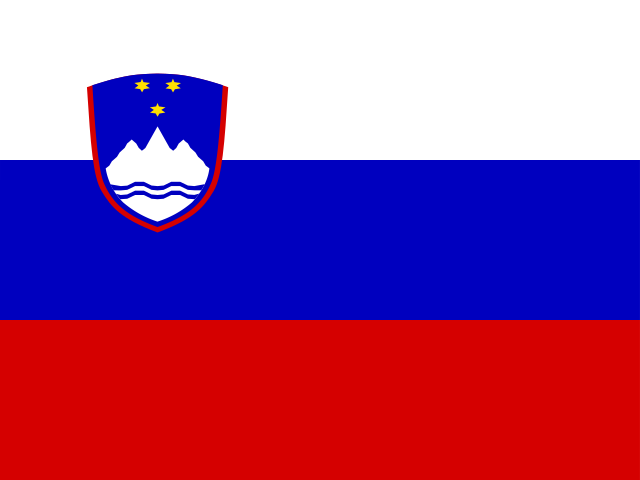
Slovenia67/100
“Two nations that have independently concluded privacy is overrated, differing chiefly in whether your business is filed via curtain-gap surveillance or a 340-member WhatsApp group with active moderators.”
Breakdown & sources
Work-Life Balance62
The articles don't address offices directly, but any culture where schnapps is socially mandatory at 9am and neighbourhood meetings are non-negotiable civic obligations suggests 'balance' is a concept both countries find mildly suspicious.
Hierarchy & Formality58
Slovenia defers to the recycling schedule as a moral authority; Peru defers to the vigilante as de facto municipal government — structurally similar, but one posts bylaws and the other has three moderators and an ongoing parking grievance.
Communication Style63
Slovenians relay your small talk verbatim by evening through analogue whisper networks; Peruvians simply broadcast it instantly to 340 contacts — both cultures are radically transparent, distinguished mainly by bandwidth.
Punctuality Culture55
In Ljubljana, a taxi leaving at 11pm instead of 1am is treated as data requiring immediate analysis; in Lima, showing up to the junta vecinal late means decisions proceed without you — both, in their own way, punish tardiness.
Social Bonding74
Peru earns trust slowly then grants it totally; Slovenia grants you schnapps immediately and surveys you indefinitely — the destination is identical communal warmth, the journey is merely one of observation versus immersion.

Poland52/100
“Two cultures that both take Sunday seriously, but disagree so fundamentally on what that means that any joint weekend would end with one party full, the other exhausted, and neither quite sure what happened.”
Breakdown & sources
Work-Life Balance58
Both nations guard their leisure with fierce conviction — Poland through enforced silence, Peru through enforced feasting — which is compatible in principle and utterly irreconcilable in practice.
Hierarchy & Formality55
Insufficient evidence to score with precision, though any culture that treats a garden allotment invitation as a genuine honour and one that treats a Sunday lunch as a three-hour family obligation are probably operating on similar unspoken social contracts.
Communication Style44
Poland's quiet, unhurried weekend register sits at an uncomfortable distance from Peru's loud, unplanned, everyone-just-showed-up energy — one nation signals warmth through restraint, the other through volume.
Punctuality Culture60
Peru's explicit 'arrive a little late — it's normal' finds no obvious Polish counterpart, though a culture that spends Sundays walking through forests in silence is unlikely to be timing arrivals to the minute either.
Social Bonding47
Both cultures bond intensely over food and family, but the Polish model is a quiet soup with people you already trust, while the Peruvian model is a three-hour almuerzo that expands to accommodate whoever wandered in — a meaningful distinction.

Austria38/100
“Two countries that both take leisure extremely seriously and have reached completely opposite conclusions about what it means.”
Breakdown & sources
Work-Life Balance32
Peru devotes the weekend to compulsory collective feasting; Austria devotes it to hiking alone in expensive boots past every closed shop in the country — both are deeply committed to leisure, and neither would survive the other's version of it.
Hierarchy & Formality35
Austria requires formal address, correct dialect, and the quiet approval of strangers; Peru requires warmth, patience, and a willingness to point at things until someone understands you.
Communication Style28
Austria expects near-native fluency and judges its absence in silence; Peru rewards eight words of Spanish and a hopeful gesture with genuine warmth — a compatibility gap wide enough to order the wrong coffee in.
Punctuality Culture42
Austria enforces a noise ordinance on Sunday lawn-mowing; Peru considers 'around 1pm' a loose philosophical position rather than a commitment — they are, technically, both thinking about time.
Social Bonding44
Peruvians bond through mandatory family lunches from which refusal is a betrayable offence; Austrians bond through hours-long Kaffeehausculture, which achieves the same intimacy at roughly one-fifth the caloric cost.

Germany34/100
“A nation that treats the checkout line as a moral examination meets a nation that treats the market stall as a social occasion — compatibility exists mainly in the shared act of purchasing food, and nowhere else.”
Breakdown & sources
Work-Life Balance38
Germany enforces leisure with the same grim discipline it applies to productivity; Peru simply doesn't recognize the distinction between commerce, community, and Tuesday morning.
Hierarchy & Formality41
German formality is institutional and cold, Peruvian formality is relational and warm — both countries have rules, but one prints them in a manual and the other whispers them through a decade of Tuesday tomato transactions.
Communication Style22
The German cashier who considers eye contact an unnecessary transaction overhead will find the Peruvian market vendor — who considers eye contact an opening bid for a twenty-minute relationship — something close to a personal affront.
Punctuality Culture30
In Germany, being three minutes late to the checkout is a small ethical failure; in Peru, the checkout itself has not yet decided when it will begin.
Social Bonding29
One culture bonds over shared silence and correctly sorted recyclables; the other bonds over free cheese samples and unsolicited commentary on your diet — a Venn diagram with essentially no overlap.

South Korea34/100
“Two countries united by a shared genius for making the simple impossible, divided by whether the obstacle is a rubber stamp or a CAPTCHA.”
Breakdown & sources
Work-Life Balance42
Peru's manana-adjacent patience and Korea's productivity-at-all-costs intensity occupy opposite ends of the burnout spectrum, though both will consume your afternoon in a queue of some kind.
Hierarchy & Formality38
Both cultures reward deference to institutional authority, but Peru's is embodied in the teller behind the glass while Korea's is encoded in a digital certificate you cannot install without administrator privileges.
Communication Style31
Peru asks you to explain yourself in person, across a counter, twice; Korea asks you to do the same through an app that has not been translated since 2019.
Punctuality Culture28
Korea's schedule-as-contract rigidity and Peru's schedule-as-suggestion flexibility share only the feature that your appointment will, in the end, mean very little.
Social Bonding36
Both cultures warm considerably once the paperwork is behind you, though in Peru that may be weeks away and in Korea it is gated behind a phone plan you still don't have.

Switzerland21/100
“A nation that has elevated the timetable to scripture meets a nation that treats the timetable as a loose suggestion, and the resulting culture clash runs considerably deeper than the question of whether the bus will stop.”
Breakdown & sources
Work-Life Balance35
Insufficient published data to score precisely, but a country where the commute home is itself an extreme sport and a country where the train arrives to the second occupy meaningfully different relationships with the concept of 'the day ending on time.'
Hierarchy & Formality30
Switzerland's laminated sacred texts and quietly disappointed conductors suggest a culture of rule-enforcement so thorough it has become personality; Peru's fare-as-suggestion commbi economy suggests authority is more of a starting position in a negotiation.
Communication Style22
One culture communicates via a man hanging out a door shouting destinations like a distressed auctioneer; the other communicates via a silence so weaponised it can be deployed across an entire quiet carriage.
Punctuality Culture4
Switzerland runs at 99.5% on-time and considers ninety seconds a moral failing; Peru runs on faith, elbows, and the metaphysics of 'eventually' — a gap so vast it is less a cultural difference than a disagreement about the nature of time itself.
Social Bonding28
Peruvians bond through shared improvisation and elbow-contact on a vehicle that may or may not stop; the Swiss bond through the collective silent fury of a delayed tram, which is technically still bonding, if a cold and righteous variety.