← Compatibility Index
 Poland
Ranked against every country we've compared Poland to, highest compatibility first.
Canada62/100
“Two nations that have independently discovered the same life hack — pay for the thing that's technically free — and will never admit this to each other at a dinner party.”
Breakdown & sources
Work-Life Balance63
Both countries nominally protect leisure time with one hand while quietly dismantling it with the other, though Canada at least feels guilty about it.
Hierarchy & Formality58
Canada performs egalitarianism with a sincerity that Poles find mildly suspicious, while Poland's residual formality strikes Canadians as either charming or unnecessarily stiff, depending on how much wine has been served.
Communication Style55
Canada's compulsive indirectness and Poland's blunt matter-of-factness are not technically the same language even when both parties are speaking English.
Punctuality Culture65
Both nations treat punctuality as a reasonable aspiration rather than a binding social contract, which is either common ground or a mutual alibi.
Social Bonding66
Canadians and Poles share a rare and underrated trait: a dark, self-deprecating relationship with their own national institutions, which is an excellent foundation for a friendship forged in a waiting room.

Kuwait62/100
“Two nations united by the conviction that paperwork is a moral test, divided by whether the ordeal involves a card or a number — and by almost everything else.”
Breakdown & sources
Work-Life Balance55
Both countries will keep you busy, though Kuwait's hours bend around prayer times and summer heat while Poland's bend around the quiet resignation that the office heating hasn't worked since November.
Hierarchy & Formality60
Kuwait's formality runs through sponsorship and seniority; Poland's runs through forms in triplicate — different structures, equally unbothered by your personal timeline.
Communication Style58
Kuwaiti offices favour warm indirection; Polish offices favour blunt redirection to a different building — both leave you unsure of what just happened, but for opposite reasons.
Punctuality Culture65
Neither country will guarantee the office is ready for you at the appointed hour, though in Kuwait this is communicated graciously and in Poland it is communicated via a sign on a locked door.
Social Bonding52
Shared suffering in waiting rooms is a universal social lubricant, and both cultures offer it in abundance — Kuwait over tea, Poland over the grim solidarity of a numbered ticket.
Brazil54/100
“A partnership between a country where connection requires no common language and one where language is no barrier to remaining a permanent outsider — together, they will communicate constantly and understand each other intermittently.”
Breakdown & sources
Work-Life Balance55
The articles decline to settle this question, which is itself a kind of answer — two countries too busy performing their respective national temperaments to compare calendars.
Hierarchy & Formality50
Insufficient evidence from the source material, though a country with seven grammatical cases almost certainly has opinions about who addresses whom in which register.
Communication Style42
Brazil treats communication as a full-contact sport requiring no equipment; Poland has quietly built an English-language bypass around its own soul — two philosophies of connection that talk past each other with great enthusiasm.
Punctuality Culture52
The articles, arriving on their own schedule, provide no data — a lacuna that feels more Brazilian than Polish.
Social Bonding58
The Brazilian will have recruited three bystanders and ordered juice before the Pole has decided whether the situation warrants eye contact — but both, in their own way, will eventually mean it.

Peru52/100
“Two cultures that both take Sunday seriously, but disagree so fundamentally on what that means that any joint weekend would end with one party full, the other exhausted, and neither quite sure what happened.”
Breakdown & sources
Work-Life Balance58
Both nations guard their leisure with fierce conviction — Poland through enforced silence, Peru through enforced feasting — which is compatible in principle and utterly irreconcilable in practice.
Hierarchy & Formality55
Insufficient evidence to score with precision, though any culture that treats a garden allotment invitation as a genuine honour and one that treats a Sunday lunch as a three-hour family obligation are probably operating on similar unspoken social contracts.
Communication Style44
Poland's quiet, unhurried weekend register sits at an uncomfortable distance from Peru's loud, unplanned, everyone-just-showed-up energy — one nation signals warmth through restraint, the other through volume.
Punctuality Culture60
Peru's explicit 'arrive a little late — it's normal' finds no obvious Polish counterpart, though a culture that spends Sundays walking through forests in silence is unlikely to be timing arrivals to the minute either.
Social Bonding47
Both cultures bond intensely over food and family, but the Polish model is a quiet soup with people you already trust, while the Peruvian model is a three-hour almuerzo that expands to accommodate whoever wandered in — a meaningful distinction.
Japan51/100
“Two countries united by the conviction that language acquisition is a form of character-building punishment, and divided on virtually everything else.”
Breakdown & sources
Work-Life Balance48
The articles decline to weigh in, which is itself a kind of verdict — two cultures that prefer not to discuss such matters openly.
Hierarchy & Formality50
Both countries demand a specific kind of humility from outsiders, though Japan encodes it into three writing systems while Poland reserves it for the seventh grammatical case.
Communication Style44
Poland will let you believe you're following the conversation right up until the noun endings mutate; Japan politely allows you to finish your sentence before confirming nothing was understood.
Punctuality Culture52
The source material is silent on this dimension, suggesting both nations consider tardiness either unthinkable or simply not worth discussing with foreigners.
Social Bonding55
Both countries reward linguistic effort from outsiders with genuine warmth, making the respective barriers less a wall than a particularly unpleasant entrance exam.
Chile48/100
“Two nations that both take their holidays extremely seriously and would therefore be horrified by each other's definition of the word.”
Breakdown & sources
Work-Life Balance52
Both cultures will shut the entire country down without apology — Chile just does it with a terremoto in hand and a cueca in progress, while Poland does it in candlelit silence with six more courses still to come.
Hierarchy & Formality45
Poland's reverent, obligation-heavy holiday structure suggests a culture comfortable with solemn duty, which will unsettle Chileans who have institutionalised the fonda as proof that national feeling is best expressed through enthusiastic dancing with strangers.
Communication Style40
Chile communicates holiday joy by correcting your cueca handkerchief technique out of genuine civic concern; Poland communicates it by leaving you standing outside a locked supermarket until you understand.
Punctuality Culture55
Neither country is negotiating on its calendar — the 18th is the 18th, Wigilia is Wigilia — but Chile's fortnight-long national bender and Poland's precisely observed full stop represent philosophically incompatible approaches to what 'closing early' means.
Social Bonding47
Both cultures treat a holiday invitation as a serious social contract you decline at your peril, though one seals it with an asado and a flag, and the other with an empty plate set for the absent and several hours of deliberate silence.

Australia48/100
“A partnership between a country that greets strangers with tongs and a cold beer, and one that considers eye contact in a lift a mild act of aggression — theoretically functional, emotionally exhausting.”
Breakdown & sources
Work-Life Balance55
Both cultures guard their off-hours with genuine conviction, though one enforces this via enforced 'cisza nocna' quiet-hour ordinances and the other via the sacred, non-negotiable sanctity of the weekend BBQ.
Hierarchy & Formality45
Poland's building-committee formalism and carefully observed social distance sit at a notable angle to Australia's cheerful insistence on treating everyone, including the neighbour they met forty seconds ago, as a mate.
Communication Style35
Australia's default setting is enthusiastic disclosure to near-strangers; Poland's is polite reserve maintained with such discipline that a nod in a stairwell counts as a warm exchange.
Punctuality Culture62
A rare point of quiet convergence: both countries take shared civic obligations — noise curfews, bin rosters, snow-clearing duties — with a seriousness that suggests punctuality, at least toward community rules, is not entirely lost on either.
Social Bonding30
One country will have you in someone's backyard with a sausage in hand before you've unpacked a single box; the other considers an unsolicited knock on a neighbour's door a minor social transgression requiring explanation.

Kenya42/100
“Two cultures that take socialising with the utmost seriousness, having reached entirely opposite conclusions about what that means — one counts flower stems for omens, the other counts venues as a minimum.”
Breakdown & sources
Work-Life Balance45
Kenya's approach treats the evening as a multi-venue endurance sport, while Poland treats leisure as a deliberate ritual — both are exhausting, just on different schedules.
Hierarchy & Formality38
Poland's hand-kissing, bill-paying formalism and Kenya's rolling group-chat social democracy are operating from manuals that have never been in the same library.
Communication Style35
One culture treats an unanswered text as a genuine social offence requiring reflection; the other treats a WhatsApp group as a living organism that simply never sleeps.
Punctuality Culture44
Poland's deliberate, staged courtship script implies appointments are kept; Kenya's fluid three-location evenings suggest the word 'schedule' is being used loosely by all parties.
Social Bonding48
Both nations are, to their credit, genuinely serious about socialising — they simply cannot agree on whether bonding requires a bouquet or a group chat and an unnamed third venue.

Vietnam41/100
“One culture has legislated rest into existence by force of law; the other has legislated rest out of existence by force of habit — a pairing that will agree on nothing except that the other side is doing weekends catastrophically wrong.”
Breakdown & sources
Work-Life Balance28
Poland closes the shops by parliamentary decree to enforce leisure; Vietnam simply never received the memo that leisure and commerce are supposed to be separate activities.
Hierarchy & Formality50
The articles decline to rule on this dimension, which is itself a kind of verdict — both cultures keep their power structures politely off the weekend itinerary.
Communication Style50
Insufficient evidence from the published reporting, though a midnight bún chả negotiation and a locked Biedronka sign suggest both cultures communicate their intentions with perfect, unambiguous finality.
Punctuality Culture45
Vietnam's golden-hour dawn discipline and Poland's Saturday-evening grocery heist both suggest a society that plans obsessively around externally imposed deadlines — just different ones.
Social Bonding52
The plastic stool and the Sunday family lunch are spiritually identical institutions dressed in wildly different clothes — both revolve around food, unhurried time, and the implicit understanding that showing up is mandatory.

Qatar38/100
“Poland and Qatar are two countries that have both decided healthcare tells you everything you need to know about a culture — one treats it as a luxury amenity, the other as a public endurance sport — and the rest of their compatibility follows accordingly.”
Breakdown & sources
Work-Life Balance35
Qatar's employer-sponsored everything model and Poland's state-subsidised stoicism represent two entirely different philosophies on who owes whom what outside working hours.
Hierarchy & Formality40
Qatar's deference runs through employer-sponsor relationships and institutional polish, while Poland's runs through grey waiting rooms and queue number tickers — different architectures of submission, equally immovable.
Communication Style42
Qataris navigating a multilingual expat services culture and Poles who've never guaranteed English at a public counter are both, in their own way, asking you to do a little more homework before you arrive.
Punctuality Culture30
In Qatar, a specialist sees you within the hour; in Poland, 'next available' is a concept flexible enough to encompass entire seasons — the two countries do not share a definition of the word 'soon.'
Social Bonding43
Poland bonds over shared suffering — snacks in the NFZ waiting room, dark humour about the system — while Qatar bonds over shared amenity, which is a perfectly pleasant way to never quite get close to anyone.
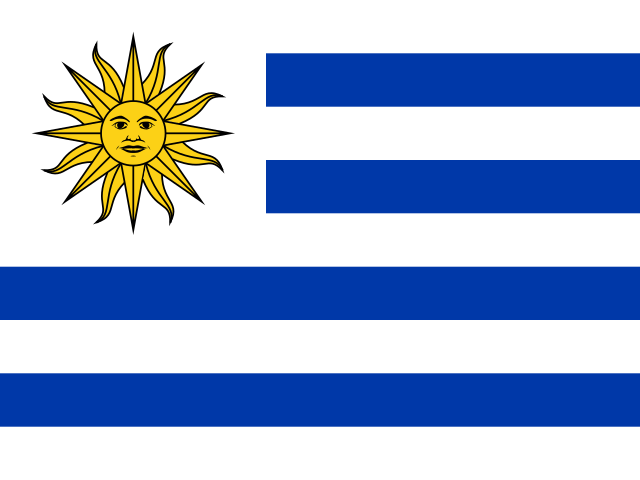
Uruguay38/100
“Two nations that both take their tomatoes seriously, but one treats the transaction as a social occasion and the other treats it as an obstacle to be cleared at speed — a compatibility gap that extends, one suspects, well beyond the produce aisle.”
Breakdown & sources
Work-Life Balance45
Uruguay's feria culture suggests a civilisation that has made peace with time; Poland's cashier velocity suggests a civilisation that has declared war on it.
Hierarchy & Formality42
Uruguay's vendor relationships reward regulars with better fruit through accumulated social capital, while Poland's till interactions dispense with relationship-building as an unnecessary overhead.
Communication Style28
In Uruguay, buying tomatoes involves at least one unsolicited meteorological opinion; in Poland, chatting with the cashier is a documented social offence.
Punctuality Culture35
Poland's checkout queue communicates displeasure through competitive sighing, while Uruguay's feria operates on an entirely separate metabolism — one that treats closing time as a loose suggestion.
Social Bonding40
Uruguay builds community through fifteen-minute tomato negotiations; Poland builds community through the shared ordeal of surviving the checkout lane.
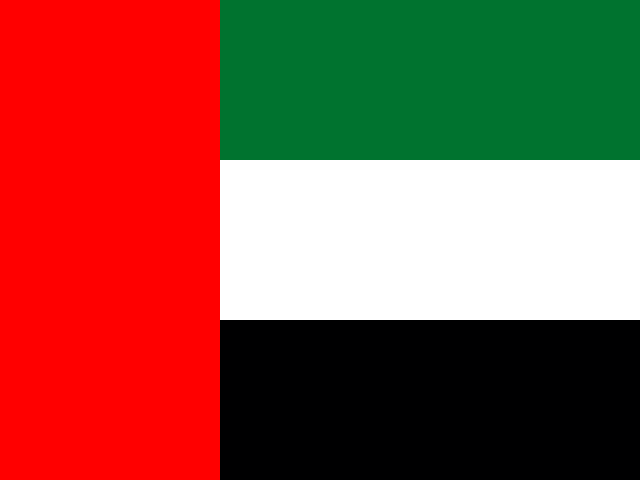
UAE38/100
“Two countries united by a shared conviction that public space is not for frivolity, yet divided by essentially everything else, including which rules are enforced by social disapproval and which by the state.”
Breakdown & sources
Work-Life Balance45
Poland guards its Sundays with quiet Protestant-adjacent ferocity; the UAE structures its week around a different calendar entirely — compatible only in the sense that both cultures would like you to stop making noise.
Hierarchy & Formality42
Poland's formality is social and horizontal — a matter of manners among equals — while the UAE's is structural, layered by nationality, gender, and context, which is a rather different architecture to navigate.
Communication Style50
Poland communicates with blunt directness and expects you to receive it without weeping; the UAE communicates with studied courtesy and expects you to read between the lines — two philosophies that will politely, directly miss each other.
Punctuality Culture62
A rare point of convergence: Poles consider lateness inconsiderate, and the UAE's formal public codes suggest a culture that takes scheduled behaviour seriously, though the mechanisms of enforcement differ substantially.
Social Bonding28
Poland bonds through earned familiarity, stoic proximity, and the eventual dzień dobry; the UAE bonds through hospitality rituals, shared faith calendars, and a public/private divide so pronounced that the bonding, for outsiders, remains largely theoretical.

Colombia34/100
“Two countries that both get you where you're going, but disagree on whether the journey should involve strangers, eye contact, or any acknowledgment that other humans exist.”
Breakdown & sources
Work-Life Balance42
Colombia builds its leisure into the street infrastructure; Poland builds its leisure into a room where no one will bother you — compatible only in the sense that both countries have, technically, heard of weekends.
Hierarchy & Formality38
Poland's commuters give up seats for their elders without being asked; Colombia's commuters are simply trying to locate their own ribcage — a different kind of social contract, observed with equal seriousness.
Communication Style22
Colombia treats a public square full of strangers as an invitation to synchronised reggaetón aerobics; Poland treats a gym floor full of strangers as a library, and expects you to behave accordingly.
Punctuality Culture18
Poland has weaponised the 8:14 tram; Colombia has weaponised the concept of approximate arrival, and neither side is prepared to negotiate.
Social Bonding31
Colombia bonds through physical proximity, shared municipal speakers, and uninvited enthusiasm; Poland bonds through the mutual understanding that you will not speak to each other, ever, and finds this perfectly adequate.
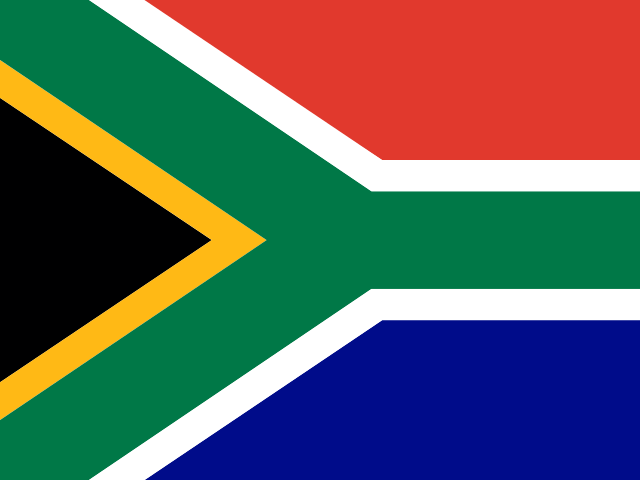
South Africa31/100
“Two countries united by the belief that their transport system works, divided by every conceivable definition of what 'works' means.”
Breakdown & sources
Work-Life Balance42
Poland treats efficiency as a moral virtue and South Africa treats flexibility as a survival strategy — a pairing that would function adequately until the first deadline.
Hierarchy & Formality38
Warsaw's 'don't expect small talk with the driver' culture and Johannesburg's gaatjie-is-always-right authority structure both involve unquestioned hierarchy, just communicated through entirely different silences.
Communication Style29
One culture communicates through digital countdown clocks accurate to the second; the other through a man leaning out of a sliding door shouting — both effective, neither translatable.
Punctuality Culture8
Poland treats a four-second tram delay as a civic emergency; South Africa has built an entire parallel economy on the philosophical position that schedules are a form of optimism.
Social Bonding35
Poles bond through shared stoic endurance of systems that work; South Africans bond through shared improvisational endurance of systems that shouldn't — warmly incompatible origin stories.

Nigeria28/100
“Two cultures that agree the weekend matters, and disagree on absolutely everything else about what that means.”
Breakdown & sources
Work-Life Balance22
Poland enshrines rest in legislation; Nigeria enshrines rest as something that happens after the third owambe of the weekend, theoretically.
Hierarchy & Formality45
Both cultures take social respect seriously — Poland through quiet reserve, Nigeria through the very specific and unforgiving protocol of greeting elders correctly at parties.
Communication Style35
Poland communicates its preferences through shuttered shop fronts and near-empty streets; Nigeria communicates through aso ebi dress codes and sprayed banknotes — both are clear, neither is subtle in the same language.
Punctuality Culture15
Poland closes its shops with the precision of a nation that believes schedules are a moral position; Lagos weekend traffic treats 'twenty minutes' as an aspirational fiction.
Social Bonding20
The Pole recovers from the week in grateful, legally-protected silence; the Nigerian recovers from the week by attending a six-hour celebration and calling it a quiet Saturday.