← Compatibility Index
 Denmark
Ranked against every country we've compared Denmark to, highest compatibility first.

Chile54/100
“Two countries united by the shared experience of making foreigners feel linguistically inadequate, though by entirely opposite methods.”
Breakdown & sources
Work-Life Balance52
Chile's long-hours culture and Denmark's constitutionally protected right to leave the office before dark suggest a partnership that will require negotiation, therapy, or both.
Hierarchy & Formality45
Chile's respect for titles and seniority meets Denmark's studied indifference to both, producing the specific discomfort of one party addressing a first-name basis relationship as 'Señor.'
Communication Style48
Chile communicates in rapid, consonant-depleted Spanish that defeats other Spanish speakers, while Denmark communicates in English so fluent it defeats Danish learners — a perfect symmetry of mutual humiliation.
Punctuality Culture44
Chile's elastic relationship with scheduled start times and Denmark's quiet assumption that being on time is the bare minimum of adult functioning leave one party waiting and the other quietly judging.
Social Bonding58
Chileans warm quickly and loudly, Danes warm slowly and sincerely, meaning the Chilean will have declared a best friend before the Dane has finished deciding whether to make eye contact.

Brazil52/100
“Two countries equally committed to physical fitness, separated by the minor detail that one does it accidentally in a wool coat and the other does it intentionally in almost nothing.”
Breakdown & sources
Work-Life Balance58
Both nations have made peace with not overworking, though Denmark achieved this through Lutheran pragmatism and Brazil through what can only be described as a national consensus that there is always a beach nearby.
Hierarchy & Formality55
Denmark's flat, egalitarian office culture and Brazil's warmly informal social rituals suggest broad alignment, provided the Brazilian side can resist the urge to hug someone who has not yet been introduced.
Communication Style44
The Dane communicates in precise, economical sentences; the Brazilian communicates in full body, full volume, and occasional follow-up text messages — a gap that is charming for approximately one week.
Punctuality Culture33
A Dane who says 7pm means 6:58; a Brazilian who says 7pm is still deciding what to wear at 8:15, and both parties consider their approach to be the obviously correct one.
Social Bonding60
Both cultures bond readily through physical activity in public spaces — one via a silent, nodding cycle commute, the other via a spontaneous footvolley match that somehow lasts until midnight.

Thailand42/100
“Two nations that both value green space and leisure, separated by the small matter of climate, monitor lizards, and the philosophical distance between 'hygge' and 'survival aerobics at 6am before the sun turns lethal.'”
Breakdown & sources
Work-Life Balance52
Both cultures treat leisure as a genuine priority, though Denmark schedules it around candlelight and Thailand schedules it around not dying of heatstroke.
Hierarchy & Formality38
Denmark's blanket-sharing-with-strangers egalitarianism and Thailand's carefully tiered social fabric suggest these two countries have reached very different conclusions about what 'being relaxed' actually means.
Communication Style45
The Dane offers quiet, unhurried conversation as the default social setting; the Thai park-goer is doing synchronised aerobics to pop music at dawn — both are perfectly content, but not quite talking to each other.
Punctuality Culture50
Denmark arrives at the park when the mood is right; Thailand arrives at the park precisely when the sun has not yet become a public health emergency — both, in their own way, are on time.
Social Bonding44
Fællesspisning and free public aerobics classes are both cheerful, communal, and open to strangers, which is where the resemblance ends and the monitor lizard begins.

South Korea41/100
“Two punctuality utopias separated by everything else: Denmark built a civilisation around doing less, South Korea built one around doing more, and neither has the slightest intention of compromising.”
Breakdown & sources
Work-Life Balance18
Denmark treats the 37-hour week as a constitutional right; South Korea treats it as a starting point for negotiation, and the negotiation only goes one direction.
Hierarchy & Formality22
Danes are on first-name terms with their CEOs before the introductory handshake is finished; Koreans have a grammatical tier system for seniority that takes years to navigate without causing offence.
Communication Style35
Danish directness and Korean indirectness are not merely different styles but competing philosophies about whether the point of speech is to convey information or to preserve the room's harmony.
Punctuality Culture72
The one area of genuine kinship: both nations have quietly decided that being late is a moral failing, they simply disagree on absolutely everything else.
Social Bonding30
Hygge and hoesik are both ritualised forms of enforced togetherness, but one involves candlelight and an opt-out, while the other involves soju and a hierarchy that makes opting out professionally inadvisable.

Vietnam38/100
“Two nations that have both solved healthcare access, via entirely opposite philosophies, which turns out to be a reasonable metaphor for every other dimension of their relationship.”
Breakdown & sources
Work-Life Balance42
Denmark treats leisure as a civic right enshrined in labour law; Vietnam treats the boundary between work and life as a charming theoretical construct.
Hierarchy & Formality28
Danish flat-hierarchy egalitarianism meets Vietnamese deference-to-seniority culture with the gentle collision of two very confused org charts.
Communication Style35
Danes say exactly what they mean and expect you to do the same; Vietnamese communication operates on contextual layers that Danes will mistake for agreement until it is too late.
Punctuality Culture44
Denmark's bureaucratic patience is measured in weeks-per-GP-appointment, while Vietnam's is measured in the approximate arrival window of 'sometime this afternoon,' and neither party finds this contradictory.
Social Bonding40
Vietnamese social warmth is immediate, communal, and expressed through food pressed upon you before you've sat down; Danish warmth is genuine but arrives on a six-month delay after you've proven yourself.
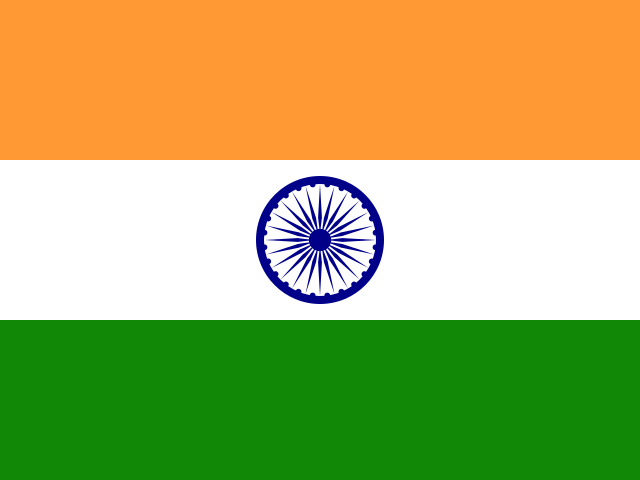
India38/100
“One culture engineered coziness into a brand and charges accordingly; the other converted actual palaces into hotels and still somehow undercharges — a pairing united only by the conviction that a guest deserves to feel something, and divided on absolutely everything else.”
Breakdown & sources
Work-Life Balance32
Denmark has legislated the right to leave the office; India has spiritualized the right to never stop serving — atithi devo bhava does not come with an out-of-office reply.
Hierarchy & Formality28
In India, a maharaja's palace staff will remember your name and your rank; in Denmark, the boutique hotel has four staff total and the owner is also the bellhop, and he finds the distinction faintly embarrassing.
Communication Style42
India communicates hospitality through warmth, scale, and enthusiastic personal engagement; Denmark communicates it through one precisely positioned Jacobsen chair and expects you to feel it without being told.
Punctuality Culture35
Denmark's design hotels run lean, with staffed hours that end promptly and no apologies offered; India's smaller properties run on warmth that arrives eventually, with apologies offered warmly and at length.
Social Bonding52
Both cultures share a genuine, almost philosophical commitment to making a guest feel something — they simply disagree on whether that requires candles and restraint or marble floors and a staff of forty.

Jordan34/100
“A country that treats cycling hand signals as civic duty meets a country that treats horn use as conversation — compatibility exists mainly in the sense that both parties will eventually arrive somewhere.”
Breakdown & sources
Work-Life Balance38
Denmark's disciplined infrastructure implies a culture that respects your time off; Jordan's cheerful willingness to drive you the long way round for the scenic experience suggests time is a more negotiable resource altogether.
Hierarchy & Formality42
Jordan operates on relationship hierarchies — your regular taxi driver outranks a stranger with an app — while Denmark operates on civic ones, where the cargo bike has right of way regardless of who you know.
Communication Style28
One culture communicates through silent, rehearsed cycling choreography; the other communicates through the horn, and means it warmly — a pairing in which every message will require translation.
Punctuality Culture22
Copenhagen's S-trains run on schedules that border on the philosophical, while Amman traffic flows on assertive merging and hills that slow things more than distance suggests — a gap measurable in both minutes and worldview.
Social Bonding48
Jordanians bond over a detour nobody asked for but everyone appreciated; Danes bond over surviving a winter commute nobody complained about — different rituals, but both cultures do, in their way, insist on earning your company.

Colombia31/100
“A pairing in which one side treats a wink from a stranger as ambient courtesy and the other treats a wink from a stranger as a formal declaration requiring three years of prior paperwork.”
Breakdown & sources
Work-Life Balance45
Both countries take time off seriously, though Colombia does so with dancing and Denmark does so with a silence so comfortable it would require a therapist to diagnose in most other latitudes.
Hierarchy & Formality38
Colombia's warmth and rapid familiarisation with everyone from the taxi driver upward sits uneasily beside Denmark's flat social architecture, which is horizontal but frostily guarded at the perimeter.
Communication Style22
Colombia resolves ambiguity by treating it as disrespect; Denmark resolves it by sitting in it for four hours at a dinner party until a third party intervenes out of secondhand embarrassment.
Punctuality Culture50
The articles offer no direct evidence either way, which is itself a kind of diplomatic silence both cultures might appreciate for entirely different reasons.
Social Bonding18
Colombia bonds instantly, physically, loudly, and possibly before you have finished ordering your drink; Denmark bonds eventually, quietly, and only after akvavit volume has exceeded social inhibition.

Egypt28/100
“Two nations that have both solved the problem of getting from A to B, but whose solutions are so philosophically irreconcilable that placing them in the same city would constitute a public order offence.”
Breakdown & sources
Work-Life Balance35
Denmark treats boundaries as a civic virtue enforced by ambient disapproval; Egypt treats them as a starting point for negotiation that may or may not conclude before midnight.
Hierarchy & Formality30
The Danish office has abolished hierarchy so thoroughly that nobody will tell you what to do, while the Egyptian office has preserved it so thoroughly that nobody will admit what is actually happening.
Communication Style22
Egyptians have developed a full horn-based grammar with syntax and tonal inflection; Danes permit exactly one polite ding, and consider that sufficient.
Punctuality Culture20
Danish ticket inspectors are 'unsentimental' in a way that suggests they were personally wronged by lateness; Cairo's microbus drivers are conducting rolling negotiations with time itself.
Social Bonding32
Cairenes cross roads as a collective, making telepathic eye contact with strangers; Danes make eye contact with no one and will instead ring a bell at you and expect you to feel remorseful about it.