← Compatibility Index
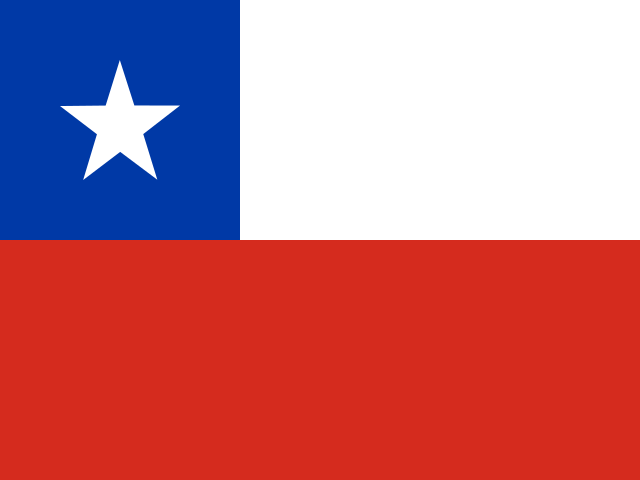 Chile
Chile
Ranked against every country we've compared Chile to, highest compatibility first.
United Kingdom54/100
“Two nations united by a shared genius for building systems that require you to already be inside the system before they will let you in.”
Breakdown & sources
Work-Life Balance55
Neither country's bureaucracy suggests a culture that believes your time is particularly valuable, though Chile at least makes you suffer in person rather than via a two-to-six-week postal queue.
Hierarchy & Formality58
Chile's insistence on physical stamped paperwork and Britain's reverence for the official letter suggest two societies that trust documents more than people, which is at least a compatible form of institutional mistrust.
Communication Style48
Chile will tell you to your face that you've brought the wrong documents; Britain will simply never call you back, leaving you to deduce the same conclusion over six weeks.
Punctuality Culture50
Both countries will make you wait an indeterminate and poorly communicated amount of time — Chile in a physical queue, Britain in a state of epistolary suspense.
Social Bonding57
Shared suffering is a universal bonding mechanism, and expats in both countries have independently discovered that complaining about bureaucracy on internet forums is the fastest route to community.
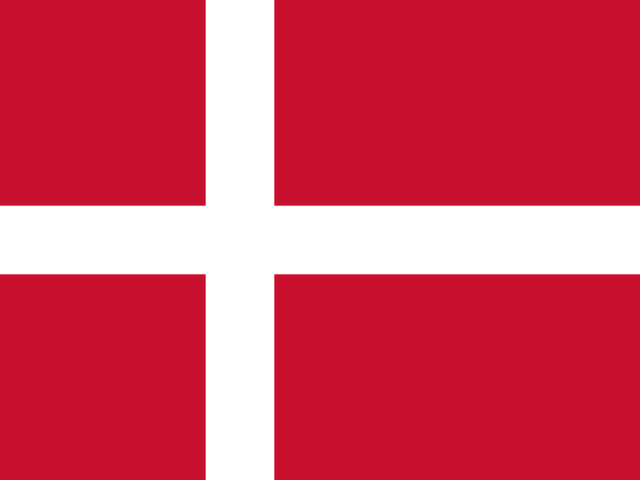
Denmark54/100
“Two countries united by the shared experience of making foreigners feel linguistically inadequate, though by entirely opposite methods.”
Breakdown & sources
Work-Life Balance52
Chile's long-hours culture and Denmark's constitutionally protected right to leave the office before dark suggest a partnership that will require negotiation, therapy, or both.
Hierarchy & Formality45
Chile's respect for titles and seniority meets Denmark's studied indifference to both, producing the specific discomfort of one party addressing a first-name basis relationship as 'Señor.'
Communication Style48
Chile communicates in rapid, consonant-depleted Spanish that defeats other Spanish speakers, while Denmark communicates in English so fluent it defeats Danish learners — a perfect symmetry of mutual humiliation.
Punctuality Culture44
Chile's elastic relationship with scheduled start times and Denmark's quiet assumption that being on time is the bare minimum of adult functioning leave one party waiting and the other quietly judging.
Social Bonding58
Chileans warm quickly and loudly, Danes warm slowly and sincerely, meaning the Chilean will have declared a best friend before the Dane has finished deciding whether to make eye contact.
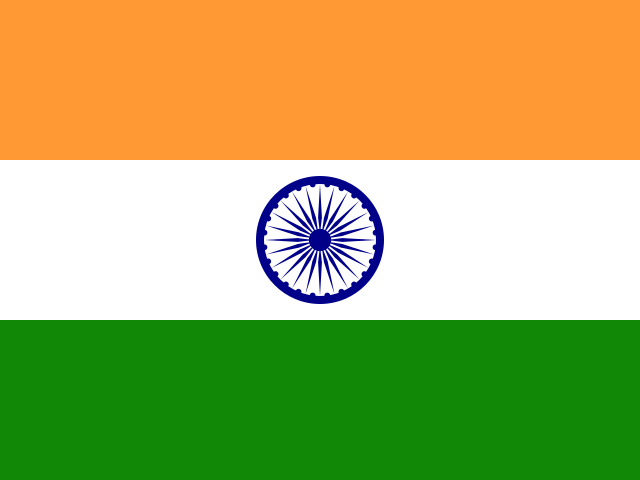
India52/100
“Two cultures that take relationships extremely seriously, but have arranged an entirely different committee to oversee the process.”
Breakdown & sources
Work-Life Balance55
Both cultures are willing to sacrifice evenings to social obligation — Chile to late dinners, India to extended family productions — though neither would describe this as an imbalance so much as correct prioritisation.
Hierarchy & Formality48
India delegates romantic authority upward to family elders with institutional efficiency, while Chile delegates it sideways to the friend group, which is a flatter org chart but no less binding.
Communication Style50
Chile has developed a precise technical vocabulary for relationship stages that India simply routes around by having the aunt handle it directly — different systems, comparable indirectness about what anyone actually wants.
Punctuality Culture60
Chile's late-night social schedule and India's elastic relationship with event start times suggest a rare point of alignment, though they arrived at this flexibility via entirely unrelated philosophical traditions.
Social Bonding58
Both societies are warmly, almost structurally, communal — Chile integrates you into the friend group immediately, India integrates you into the family across several ceremonial dinners whether you consented or not.

Poland48/100
“Two nations that both take their holidays extremely seriously and would therefore be horrified by each other's definition of the word.”
Breakdown & sources
Work-Life Balance52
Both cultures will shut the entire country down without apology — Chile just does it with a terremoto in hand and a cueca in progress, while Poland does it in candlelit silence with six more courses still to come.
Hierarchy & Formality45
Poland's reverent, obligation-heavy holiday structure suggests a culture comfortable with solemn duty, which will unsettle Chileans who have institutionalised the fonda as proof that national feeling is best expressed through enthusiastic dancing with strangers.
Communication Style40
Chile communicates holiday joy by correcting your cueca handkerchief technique out of genuine civic concern; Poland communicates it by leaving you standing outside a locked supermarket until you understand.
Punctuality Culture55
Neither country is negotiating on its calendar — the 18th is the 18th, Wigilia is Wigilia — but Chile's fortnight-long national bender and Poland's precisely observed full stop represent philosophically incompatible approaches to what 'closing early' means.
Social Bonding47
Both cultures treat a holiday invitation as a serious social contract you decline at your peril, though one seals it with an asado and a flag, and the other with an empty plate set for the absent and several hours of deliberate silence.
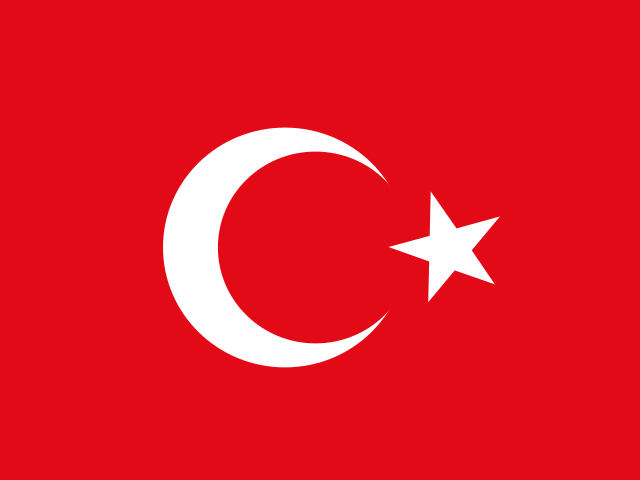
Turkey42/100
“Two countries that both enjoy a good market and a good receipt, but cannot agree on whether the price on the receipt was ever meant to be final.”
Breakdown & sources
Work-Life Balance50
The articles are silent on working hours, which itself suggests both nations are too busy to file a report.
Hierarchy & Formality48
Chile's laminated price tag and Turkey's theatrical opening offer are both, in their own way, assertions of authority — they just disagree on who holds it.
Communication Style32
Turkey conducts commerce as a three-act play involving tea and flattery; Chile prefers a monologue delivered by a fixed price tag, with no audience participation.
Punctuality Culture50
No data was furnished — though one suspects the Turkish vendor would arrive when the mood is right, and the Chilean mall would open at precisely 10:00.
Social Bonding44
Turkey bonds over negotiation and tea; Chile bonds over the mall food court — both are sincere, neither would make sense to the other.
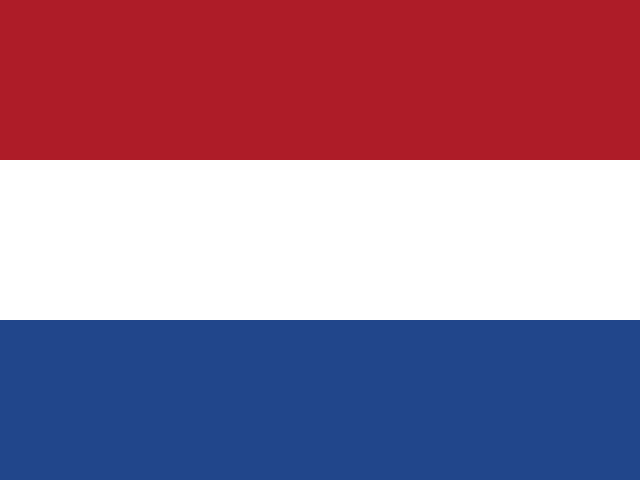
Netherlands41/100
“Two nations that both technically have functioning healthcare systems and, apparently, little else in common — one rewards urgency with access, the other rewards patience with paracetamol.”
Breakdown & sources
Work-Life Balance45
Chile's private-tier speed culture and the Netherlands' evidence-based restraint suggest two countries that define 'getting things sorted' in ways that would mutually exhaust each other.
Hierarchy & Formality38
Chile's system defers to whoever can afford specialist access, while the Dutch defer to the huisarts as an egalitarian gatekeeper — both are hierarchies, just organised around entirely different gods.
Communication Style52
Dutch doctors are noted for respecting bluntness, and Chileans are noted for asking co-pay percentages upfront — two peoples who, in a clinical setting at least, may understand each other better than expected.
Punctuality Culture44
Chile offers same-week specialist appointments to those who pay; the Netherlands offers a two-year philosophical journey toward the same outcome — compatible only if one party has excellent health insurance and infinite tolerance.
Social Bonding36
It is difficult to bond with someone who believes your request for antibiotics is a character flaw, and equally difficult to bond with someone who considers 'wait and see' a medical strategy rather than a personal affront.
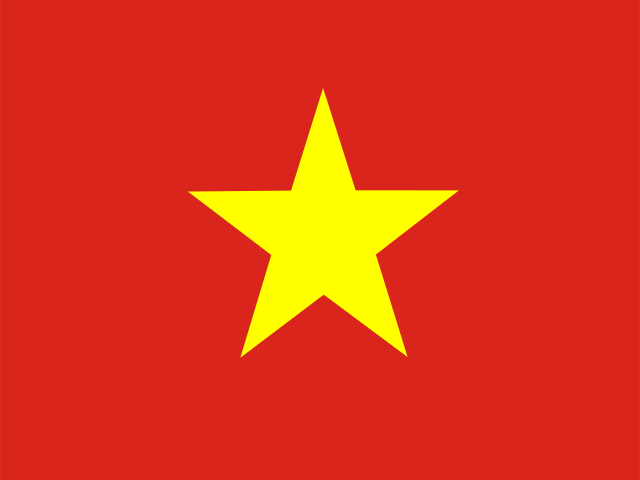
Vietnam38/100
“Two cultures that both take romance extremely seriously have somehow arrived at entirely opposite conclusions about what that means in practice — one moves at the speed of feelings, the other at the speed of family scheduling.”
Breakdown & sources
Work-Life Balance50
The articles don't venture into either country's offices, leaving this dimension in the same ambiguous state as a third date in both cultures — full of potential, entirely undefined.
Hierarchy & Formality35
Chile's dating culture skips straight to 'are we exclusive?' while Vietnam's requires clearing a parental committee first — a formality gap wide enough to seat the extended family.
Communication Style30
Chileans will ask directly about your intentions before you've finished your first drink; Vietnamese courtship prefers to let the three-hour family dinner do the asking for them.
Punctuality Culture50
No evidence either country is better or worse at arriving on time, though Chile does seem to arrive at 'serious relationship' considerably ahead of schedule.
Social Bonding42
Both cultures are emphatically group-oriented — Chile imports you into the friend circle immediately, Vietnam imports you into the family tree on roughly the same timeline, just with higher stakes and more courses.
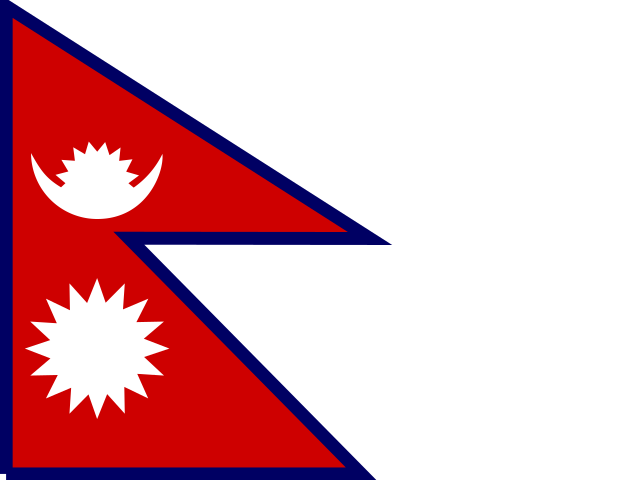
Nepal38/100
“Two countries that technically both have roads and offices, united by little else — one treats rules as a starting point for negotiation, the other treats them as a moral commitment, and neither is particularly wrong.”
Breakdown & sources
Work-Life Balance45
Insufficient data to score with confidence, though a city that budgets extra commute time for seasonal flooding and a city that runs its metro like a Swiss watch suggest rather different relationships with the concept of 'on time for dinner.'
Hierarchy & Formality40
One culture negotiates everything before committing, the other validates the card on both legs of the journey — a metaphor for their broader institutional instincts that neither side asked for.
Communication Style30
Nepal uses the horn to mean 'I exist'; Chile uses a firm social stare to mean 'you are standing on the wrong side of the escalator' — both effective, both completely illegible to the other party.
Punctuality Culture22
Santiago's metro arrives on time and Chileans have arranged their entire commuting psychology around this fact; Kathmandu's roads close during monsoon season, which is also a kind of schedule, loosely defined.
Social Bonding48
Shared suffering is a universal bonding agent, and both cultures experience the commute as a form of it — they simply disagree on whether the suffering should be orderly or thrillingly improvised.
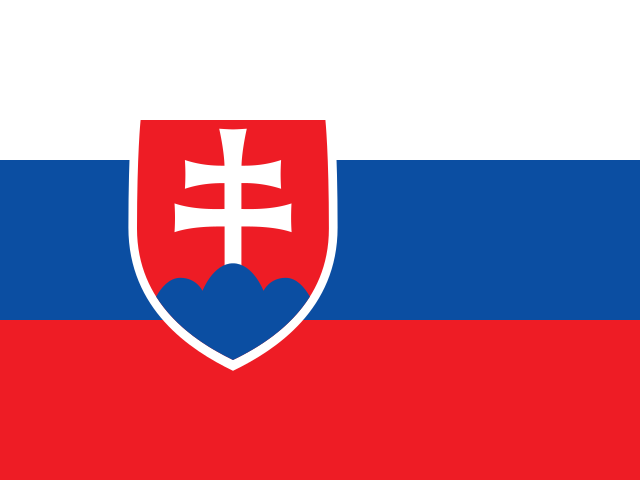
Slovakia38/100
“Two countries that both believe in community, but disagree so fundamentally on what community means that one would file a noise complaint about the other's welcome party.”
Breakdown & sources
Work-Life Balance50
Insufficient evidence from the articles to draw a sharp contrast, which is itself a kind of compatibility — both countries apparently keep their work-life tensions off the neighbours' radar.
Hierarchy & Formality45
Slovakia's reserved, patient social order and Chile's organised communal structures both imply hierarchy, just one runs on quiet deference while the other runs on WhatsApp admin privileges.
Communication Style22
Slovakia communicates through meaningful silence and a nod that means nothing more than a nod; Chile communicates through group chats, warm small talk, and the assumption that information is always communal property.
Punctuality Culture50
The articles are silent on punctuality, though one suspects the Slovak neighbour would show up to the junta de vecinos meeting exactly on time and leave before anyone learned their name.
Social Bonding18
Slovakia bonds over shared years of quiet co-existence; Chile bonds over shared laundry disputes by Wednesday — these are not the same sport, nor even the same stadium.

Finland34/100
“Two countries that have perfected the weekend in mutually exclusive ways: one insists you cannot possibly be well unless surrounded by relatives and choripán, the other insists you cannot possibly be well unless alone in a forest, and both are too committed to their respective therapies to consider a second opinion.”
Breakdown & sources
Work-Life Balance42
Both cultures guard the weekend with fierce ideological conviction — Chile just guards it with twelve family members and a grill, while Finland guards it with a lake and a formally scheduled absence from humanity.
Hierarchy & Formality38
The asador's authority over his grill is not negotiable, which is perhaps the only form of unquestioned hierarchy Finland — a country where silence outranks small talk — would find genuinely bewildering.
Communication Style18
Chile considers a four-hour conversation the minimum viable social interaction; Finland considers a comfortable silence its highest form of intimacy, meaning these two would spend a weekend together in a state of mutual, polite, irreconcilable distress.
Punctuality Culture45
Neither culture appears to be in any particular hurry — Chile because the asado ends when the last uncle decides it ends, and Finland because the mökki will still be there, silent and lakeside, whenever you arrive.
Social Bonding22
Chile bonds through enforced collective feasting and the implicit threat of a family text message; Finland bonds through shared nudity and the implicit threat of comfortable silence — two rituals that are, structurally, everything the other culture has specifically opted out of.