← Compatibility Index
 Colombia
Ranked against every country we've compared Colombia to, highest compatibility first.
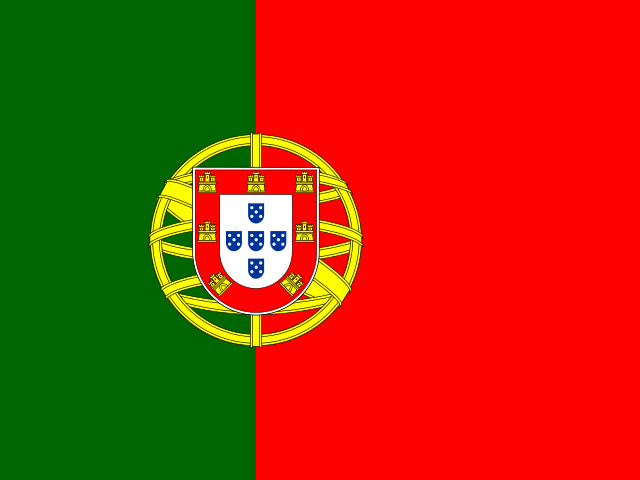
Portugal62/100
“Two nations united by a cheerful indifference to published timetables and a shared conviction that the commute is something that simply happens to you, like weather or tax.”
Breakdown & sources
Work-Life Balance68
Both cultures treat the working day as a suggestion bookended by considerably more important meals, though Portugal insists on calling this philosophy and Colombia simply calls it Tuesday.
Hierarchy & Formality60
Insufficient evidence from the published articles to score with precision, which is itself a compatible trait — neither country appears to have written the memo.
Communication Style65
Both nations communicate delays, cancellations, and general infrastructural disappointment with the serene, unhurried calm of someone who has already made peace with it.
Punctuality Culture55
Lisbon's metro is reliably late 'in the specific Portuguese way where nobody apologises,' while Bogotá's TransMilenio operates on a schedule best described as aggressive suggestion — a match made in a waiting room.
Social Bonding63
Shared suffering is a universal bonding mechanism, and both cities have generously ensured their commuters will have plenty of it to discuss over dinner.
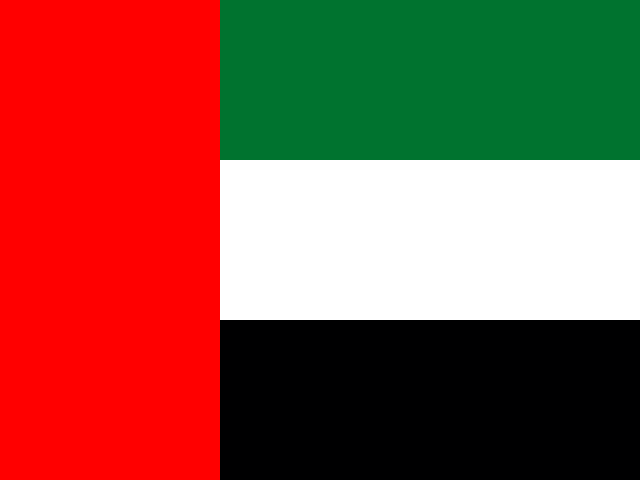
UAE52/100
“Two countries that have both technically solved healthcare arrive at entirely different philosophies about whether medicine should feel like a spa or a bureaucratic pilgrimage — a metaphor, it turns out, for nearly everything else about them.”
Breakdown & sources
Work-Life Balance48
The UAE treats downtime as something you purchase at a premium facility; Colombia treats it as something you inherit from your grandmother, ideally while she knits in a waiting room.
Hierarchy & Formality50
Both cultures respect authority, but the UAE expresses it through itemised invoices and tiered insurance plans, while Colombia expresses it through who you know at the EPS office.
Communication Style55
Dubai will tell you exactly what each cotton swab costs; Bogotá will warmly explain that the wait is only three hours, which may or may not be accurate.
Punctuality Culture44
One country has perfected the efficiency of short wait times by charging handsomely for them; the other has normalised sitting next to a knitting grandmother for an unspecified duration.
Social Bonding58
Colombians bond through shared endurance of systems that technically work; Emiratis bond through shared appreciation of systems that visibly gleam — both, remarkably, producing competent outcomes.

Austria38/100
“Austria and Colombia are two countries that have independently solved the problem of how to structure daily life and arrived at conclusions so opposite that a joint venture would require not just cultural sensitivity training but a fundamental philosophical negotiation about whether time, prices, and Sundays are fixed quantities or merely suggestions.”
Breakdown & sources
Work-Life Balance35
Austria legislates rest with the force of scripture; Colombia treats the concept of 'closed' as a loose guideline that the market has simply chosen not to enforce.
Hierarchy & Formality42
Austrian checkout queues operate on an unspoken code of conduct with consequences; Colombian market stalls operate on warmth, negotiation, and the understanding that the first price was never quite real.
Communication Style28
One culture treats the supermarket till as a transaction to be completed efficiently and in silence; the other treats a tomato purchase as a forty-minute social event from which you emerge, inexplicably, feeling victorious.
Punctuality Culture40
Austria's entire grocery infrastructure is built on the assumption that you will have planned ahead by Saturday afternoon; Colombia's is built on the assumption that you have not, and would like a tienda open at midnight just in case.
Social Bonding45
Austrians bond through shared, silent respect for the system; Colombians bond through cheerful, prolonged subversion of it — a distinction that makes joint socialising theoretically possible but spiritually exhausting.

Poland34/100
“Two countries that both get you where you're going, but disagree on whether the journey should involve strangers, eye contact, or any acknowledgment that other humans exist.”
Breakdown & sources
Work-Life Balance42
Colombia builds its leisure into the street infrastructure; Poland builds its leisure into a room where no one will bother you — compatible only in the sense that both countries have, technically, heard of weekends.
Hierarchy & Formality38
Poland's commuters give up seats for their elders without being asked; Colombia's commuters are simply trying to locate their own ribcage — a different kind of social contract, observed with equal seriousness.
Communication Style22
Colombia treats a public square full of strangers as an invitation to synchronised reggaetón aerobics; Poland treats a gym floor full of strangers as a library, and expects you to behave accordingly.
Punctuality Culture18
Poland has weaponised the 8:14 tram; Colombia has weaponised the concept of approximate arrival, and neither side is prepared to negotiate.
Social Bonding31
Colombia bonds through physical proximity, shared municipal speakers, and uninvited enthusiasm; Poland bonds through the mutual understanding that you will not speak to each other, ever, and finds this perfectly adequate.

Germany34/100
“A partnership between a country that files complaints about lateness in triplicate and one that considers the departure time a loose aspiration — compatible only in the sense that both will eventually arrive somewhere.”
Breakdown & sources
Work-Life Balance45
Germany legislates its leisure time with the same vigor it brings to infrastructure complaints; Colombia simply lives it, no legislation required.
Hierarchy & Formality38
One culture greets colleagues with careful titles and firm handshakes; the other considers a warm embrace a perfectly acceptable opening move with a near-stranger.
Communication Style32
Germany communicates with methodical directness and written evidence; Colombia communicates with expressive warmth and the understanding that tone carries more weight than transcript.
Punctuality Culture18
Germany considers a two-minute delay a moral injury requiring documentation; Colombia considers the scheduled time a polite suggestion that reality is under no obligation to honour.
Social Bonding42
Colombians bond immediately, effusively, and over anything; Germans bond eventually, sincerely, and only after sufficient shared suffering — a process the Deutsche Bahn is inadvertently accelerating.
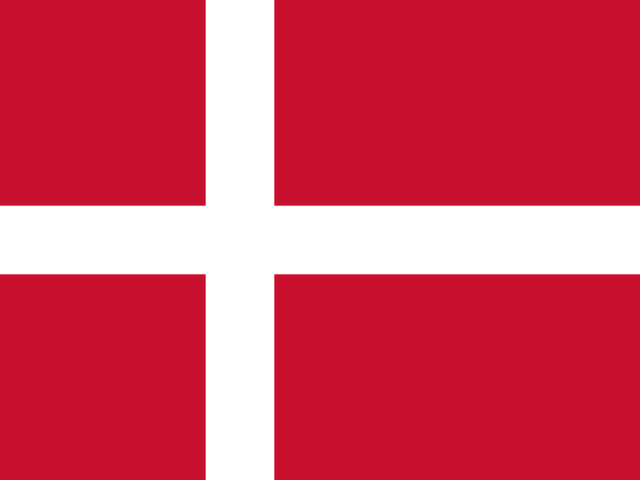
Denmark31/100
“A pairing in which one side treats a wink from a stranger as ambient courtesy and the other treats a wink from a stranger as a formal declaration requiring three years of prior paperwork.”
Breakdown & sources
Work-Life Balance45
Both countries take time off seriously, though Colombia does so with dancing and Denmark does so with a silence so comfortable it would require a therapist to diagnose in most other latitudes.
Hierarchy & Formality38
Colombia's warmth and rapid familiarisation with everyone from the taxi driver upward sits uneasily beside Denmark's flat social architecture, which is horizontal but frostily guarded at the perimeter.
Communication Style22
Colombia resolves ambiguity by treating it as disrespect; Denmark resolves it by sitting in it for four hours at a dinner party until a third party intervenes out of secondhand embarrassment.
Punctuality Culture50
The articles offer no direct evidence either way, which is itself a kind of diplomatic silence both cultures might appreciate for entirely different reasons.
Social Bonding18
Colombia bonds instantly, physically, loudly, and possibly before you have finished ordering your drink; Denmark bonds eventually, quietly, and only after akvavit volume has exceeded social inhibition.
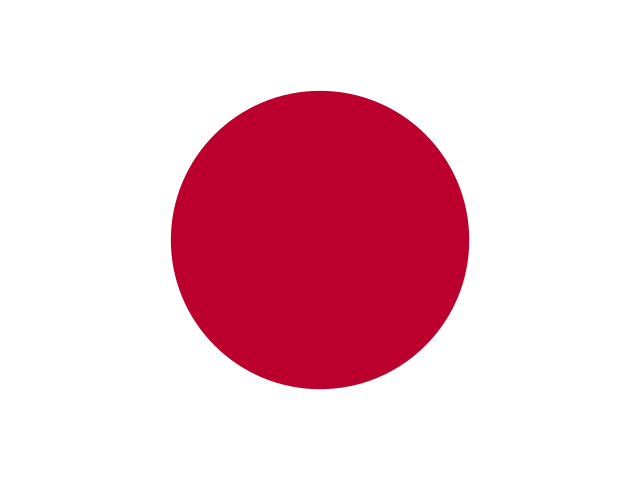
Japan31/100
“Japan and Colombia share a profound commitment to bureaucracy — Japan to perfecting it, Colombia to personalising it — and the resulting compatibility is roughly that of a metronome dating a jazz improvisation.”
Breakdown & sources
Work-Life Balance35
Japan's exhaustive, process-above-all culture and Colombia's mañana flexibility share approximately as much DNA as a hanko stamp and a compliment about someone's earrings.
Hierarchy & Formality28
Japan's formality is codified, stamped, and filed in triplicate; Colombia's is warm, discretionary, and subject to the mood of whoever happens to be at the desk — which is not the same thing at all.
Communication Style30
One culture communicates through precisely observed silence and correct procedure; the other communicates through charm, personal connection, and a well-timed compliment — a pairing that will confuse both parties equally.
Punctuality Culture22
Japan's 'same-day activation takes weeks but arrives on the minute it was promised' and Colombia's 'tomorrow, probably' are philosophically irreconcilable positions on the nature of time itself.
Social Bonding42
Warmth, in Colombia, is the lubricant of all things; in Japan, it is a private matter conducted after hours and at considerable expense — progress, then, but glacial.