← Compatibility Index
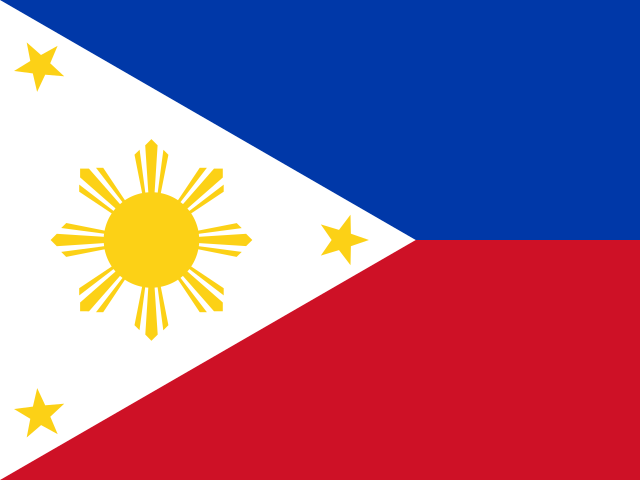 Philippines
Ranked against every country we've compared Philippines to, highest compatibility first.
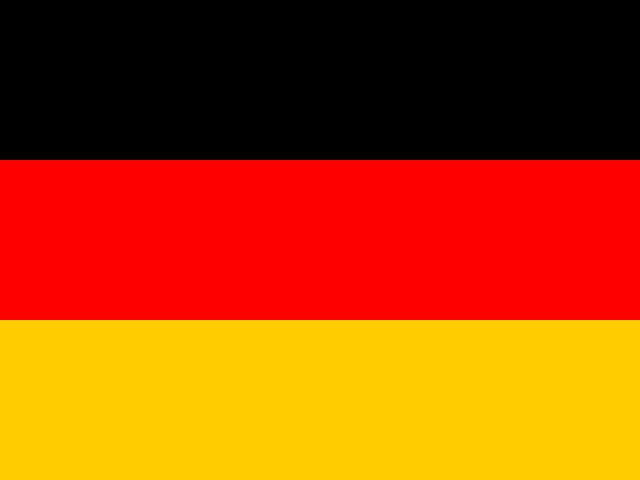
Germany34/100
“A nation that schedules its relaxation three weeks in advance has met a nation that schedules nothing and invites everyone — the resulting weekend would be either a spiritual awakening or a noise complaint.”
Breakdown & sources
Work-Life Balance28
Germany protects leisure with the force of statute; the Philippines achieves it through forty relatives and a karaoke machine — both work, neither translates.
Hierarchy & Formality45
The articles are silent on corporate rank, but a culture that enforces quiet hours by law and one that issues food as a command share, at minimum, a mutual respect for authority in unexpected forms.
Communication Style38
Germans cancel plans only under circumstances equivalent to a death in the family; Filipinos never made the plan to begin with, yet everyone arrives on time — the miscommunication is structural.
Punctuality Culture30
One culture books the hike three weeks out and leaves at the agreed minute; the other considers the tita's arrival time an opening act, not a schedule.
Social Bonding29
Kaffee und Kuchen at 4pm with four people and a structured itinerary versus a Sunday lunch that absorbs, without warning, thirty guests and a debut — both are hospitality, recognisably, from a great distance.
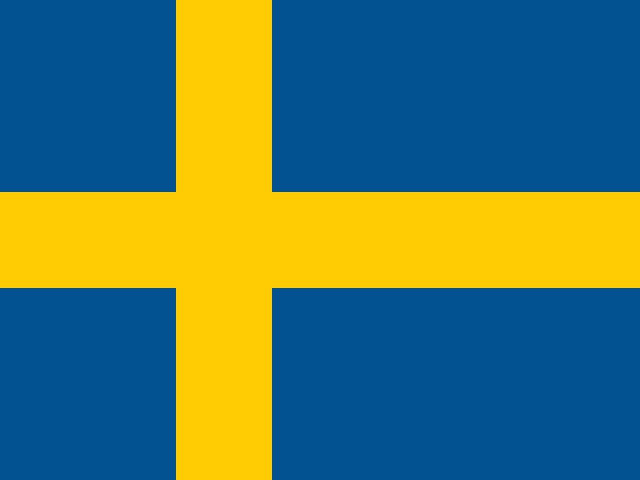
Sweden34/100
“Two nations that have independently solved the problem of healthcare — one with money, one with time — and are unlikely to agree that the other's solution counts as solving anything.”
Breakdown & sources
Work-Life Balance40
The Philippines works hard because financial precarity demands it; Sweden works reasonable hours because the state has removed the sharper teeth of precarity — a philosophical gap that polite conversation cannot bridge.
Hierarchy & Formality35
A culture where hospital receptionists calmly demand deposits from distressed relatives without breaking eye contact will find Sweden's flat, consensus-driven institutions not so much refreshing as faintly incomprehensible.
Communication Style38
Filipino warmth and elaborate social cushioning meet Swedish directness and comfortable silence — both sides will spend the first month convinced the other is being rude.
Punctuality Culture42
Sweden will book your appointment five weeks out and expect you at the dot; the Philippines will see you tomorrow morning and ask you to bring a deposit — different urgencies, neither of them punctuality in the Swedish sense.
Social Bonding30
One country bonds over food, family, and the cheerful acknowledgment that everyone is in some financial jeopardy together; the other bonds, eventually, after several winters, over coffee and the quiet dignity of the welfare state.
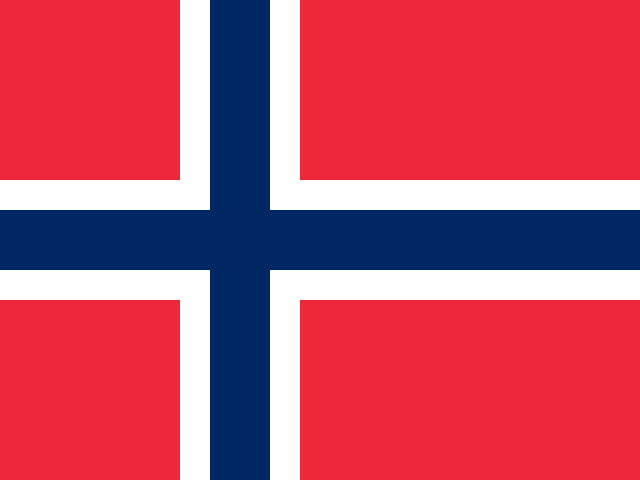
Norway28/100
“One country treats romance as a cryptic solo hike best completed in silence; the other deploys the extended family as a welcoming committee before the appetizers arrive — compatibility exists, technically, in the same way that a monastery and a fiesta exist on the same planet.”
Breakdown & sources
Work-Life Balance42
Norway guards private time with the zeal of a border control agent, while the Philippines folds work, family, and social obligation into one seamless, never-ending occasion — both value life outside the office, but they disagree fundamentally on whether that life should be quiet or crowded.
Hierarchy & Formality30
Norway's egalitarian instinct insists everyone split the bill and no one bow to anyone, while the Philippines expects visible, sincere deference to elders and parents from the first forty minutes of acquaintance — one culture flattens hierarchy on principle, the other builds its social architecture entirely upon it.
Communication Style15
The Norwegian communication style is a summit reached after three hours of silence and rewarded with the phrase 'this was nice,' whereas Filipino courtship is a semi-public declaration performed before a live studio audience of aunts — these are not merely different dialects but different theories of what language is for.
Punctuality Culture48
The articles offer no direct evidence on punctuality, but a culture that plans wedding menus forty minutes into a first introduction and one that requires six months of silence before commitment are, at minimum, operating on incompatible clocks.
Social Bonding12
Norway bonds through shared restraint, mutual independence, and the quiet dignity of not asking too much of anyone, while the Philippines bonds by immediately making you a group project involving two aunts, a catering plan, and the collective emotional investment of an entire extended family — the gap here is not a gap so much as a chasm with a rope bridge.
Netherlands28/100
“A country that splits the bill on the first date meets a country that expects to meet your mother before the second — compatibility, like the check, remains deeply contested.”
Breakdown & sources
Work-Life Balance40
The Dutch treat leisure as a constitutional right; Filipinos treat family obligation as one — both prioritise life over work, but define 'life' in ways that would confuse the other entirely.
Hierarchy & Formality20
The Netherlands has largely abolished deference as a social category, while the Philippines has elevated it into an art form that begins at the dinner table and ends nowhere visible.
Communication Style15
Dutch directness — deployed cheerfully and without apology — lands in Filipino social culture roughly the way a foghorn lands in a library.
Punctuality Culture38
The Dutch arrive on time because lateness is a form of disrespect; Filipinos operate on a more forgiving temporal philosophy that treats schedules as optimistic suggestions.
Social Bonding22
One culture bonds over a gezellig bike ride and a correctly itemised dinner bill; the other bonds through extended family interrogation and generational patience — both are sincere, neither is translatable.