← Compatibility Index
 Netherlands
Ranked against every country we've compared Netherlands to, highest compatibility first.
Australia62/100
“Two countries that both believe warmly in egalitarianism, work-life balance, and cycling to meetings, yet will spend the first three years of any partnership politely disagreeing about whether they are actually friends yet.”
Breakdown & sources
Work-Life Balance68
Both nations have constructed elaborate scaffolding to support the working parent, then quietly charged them for the scaffolding.
Hierarchy & Formality72
Australia flattens hierarchy through mateship; the Netherlands flattens it through polder consensus — both arrive at the same org chart, via entirely different philosophical routes.
Communication Style58
Australian tall-poppy-syndrome whispering meets Dutch directness head-on, producing a workplace where nobody is quite sure whether the understatement was a compliment or a critique.
Punctuality Culture65
Neither country's articles flag punctuality as a crisis point, which is itself a form of cultural compatibility, if not exactly a ringing endorsement.
Social Bonding38
Australia invites you to a barbecue within 48 hours and may never truly know you; the Netherlands waits three years before acknowledging you exist — together, they have invented a friendship that is simultaneously too fast and too slow.
Global Office: Babies, Bureaucracy, and the Bill: What Australia and the Netherlands Actually Offer New ParentsGlobal Office: Barbecue Republic vs. the Velvet Barrier: How Australia and the Netherlands Make (and Don't Make) FriendsGlobal Office: The Flat Country and the Flat Org Chart: Australia vs. the Netherlands on Startup Culture
Turkey41/100
“Two countries that both enjoy a park and a good tomato, but cannot agree on whether either experience should involve strangers, noise, or feelings.”
Breakdown & sources
Work-Life Balance48
Both cultures take leisure seriously, but one has optimised it into a infrastructure project while the other treats Sunday afternoon as an open-ended family commitment with no scheduled end time.
Hierarchy & Formality38
Turkey's unsolicited tea-and-melon hospitality assumes a warmth that Dutch social geometry — enforced by a single grandmother's glance — does not naturally budget for.
Communication Style32
One country conducts commerce at full affectionate volume with free melon; the other completes an entire supermarket transaction without a syllable of human contact, and considers this a success.
Punctuality Culture44
The Dutch arrive at the park with a plan; the Turks arrive at the park with a samovar and no particular intention of leaving, which are philosophically incompatible scheduling systems.
Social Bonding33
Turkey bonds through uninvited hospitality, grilled corn, and the assumption that proximity implies friendship; the Netherlands bonds through the respectful acknowledgment that you exist and are using the correct path.

Chile41/100
“Two nations that both technically have functioning healthcare systems and, apparently, little else in common — one rewards urgency with access, the other rewards patience with paracetamol.”
Breakdown & sources
Work-Life Balance45
Chile's private-tier speed culture and the Netherlands' evidence-based restraint suggest two countries that define 'getting things sorted' in ways that would mutually exhaust each other.
Hierarchy & Formality38
Chile's system defers to whoever can afford specialist access, while the Dutch defer to the huisarts as an egalitarian gatekeeper — both are hierarchies, just organised around entirely different gods.
Communication Style52
Dutch doctors are noted for respecting bluntness, and Chileans are noted for asking co-pay percentages upfront — two peoples who, in a clinical setting at least, may understand each other better than expected.
Punctuality Culture44
Chile offers same-week specialist appointments to those who pay; the Netherlands offers a two-year philosophical journey toward the same outcome — compatible only if one party has excellent health insurance and infinite tolerance.
Social Bonding36
It is difficult to bond with someone who believes your request for antibiotics is a character flaw, and equally difficult to bond with someone who considers 'wait and see' a medical strategy rather than a personal affront.
Mexico38/100
“One country decorates altars for its beloved dead with marigolds and devotion; the other decorates itself in orange and haggles over used appliances — a pairing that suggests compatible enthusiasm for spectacle, and almost nothing else.”
Breakdown & sources
Work-Life Balance45
Mexico folds grief, memory, and family ritual into national life with baroque tenderness; the Netherlands does the same with efficiency and a secondhand toaster, which is either a different philosophy or the same one expressed in a colder climate.
Hierarchy & Formality30
Mexico's Día de los Muertos treats the dead as honoured guests requiring precise, personal ceremony; the Dutch treat their monarch as a useful excuse to day-drink in the street, suggesting a rather different relationship with authority and reverence.
Communication Style35
Mexico communicates loss through colour, marigolds, and symbolic ofrendas layered with specific meaning; the Netherlands communicates joy by wearing one colour and haggling loudly, which is technically also layered with meaning, just less of it.
Punctuality Culture42
Mexico's vigils run across two designated nights governed by tradition and regional variation; the Dutch schedule their annual personality glitch to a single date and are extremely put out when the trams don't cooperate — one culture bends time, the other files a complaint about it.
Social Bonding40
Both nations bond most intensely through their signature annual holiday — one by welcoming strangers into cemeteries to meet their dead, the other by selling them a used blender, which are two genuinely touching gestures that will never quite translate to each other.
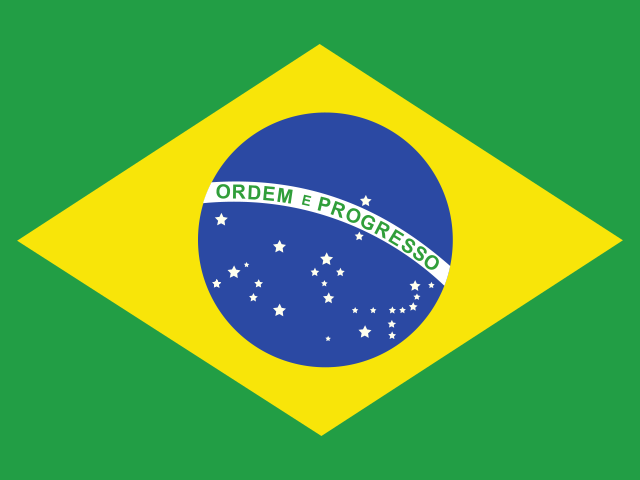
Brazil38/100
“A country that measures traffic jams in kilometres meets a country that measures civic virtue in bicycle lanes — compatibility exists mainly in the shared conviction that one's own commuting system is, somehow, fine.”
Breakdown & sources
Work-Life Balance45
Brazilians have elevated the post-commute coffee into a coping mechanism; the Dutch have simply engineered commuting into something that requires no coping.
Hierarchy & Formality50
The articles are silent on office hierarchies, which is itself informative — though one country's helicopter class and another's egalitarian bike-lane enforcement suggest the conversation will be interesting.
Communication Style35
Brazil signals bus stops with 'genuine conviction' while the Dutch signal lane violations with a bell, then vocabulary — two nations communicating urgency on entirely different frequencies.
Punctuality Culture22
One side adds double the journey time and then a coffee; the other checks in AND out of public transport with the procedural rigour of a small audit.
Social Bonding40
Dutch tolerance is warm right up until you cross a red asphalt line, whereas Brazilian warmth persists through 300-kilometre traffic jams — the upper limit of each remains untested by the other.
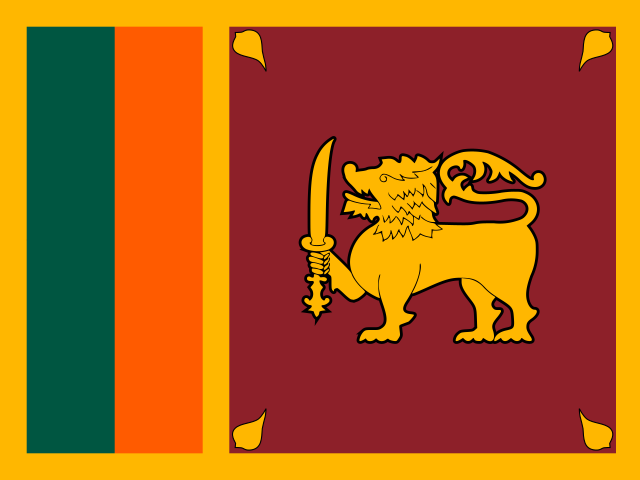
Sri Lanka38/100
“Two nations that both enjoy a good park, provided one accepts that nature is a scheduling conflict and the other accepts that a cycling path is not a suggestion.”
Breakdown & sources
Work-Life Balance45
Both cultures value outdoor leisure, but one treats it as an unstructured encounter with wildlife and the divine, while the other has organised a run club around it.
Hierarchy & Formality30
Sri Lanka's deference to temple norms and social convention coexists awkwardly with the Dutch preference for unspoken but aggressively egalitarian rulebooks.
Communication Style35
The Dutch conduct entire spatial negotiations in total silence through pointed glances at cycling lanes; Sri Lankans conduct them not at all, having ceded authority to the monkeys.
Punctuality Culture32
One culture schedules its park visits around community calendars and laminated path protocols; the other around heat, temple hours, and the unpredictable itineraries of toque macaques.
Social Bonding48
Both peoples bond warmly over shared green space — the Dutch through organised outdoor clubs, Sri Lankans through the collective trauma of watching someone lose a mango to a landlord with fur.
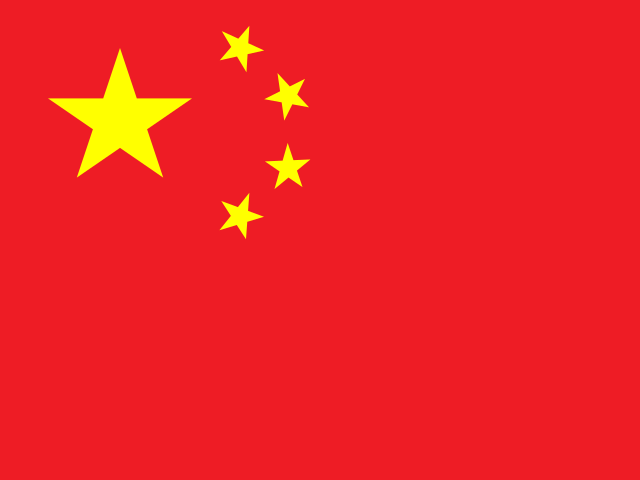
China38/100
“A nation that considers directness a civic virtue meets a nation that considers indirectness a social one, and both walk away convinced the other is being rude.”
Breakdown & sources
Work-Life Balance35
The Dutch leave the office at five with the moral certainty of people who have read the research; the Chinese stay until the boss does, which is a different kind of research entirely.
Hierarchy & Formality28
The Netherlands flattened its org chart sometime in the 1970s and has been calling managers by their first names ever since, a practice that registers in Chinese office culture somewhere between eccentric and professionally catastrophic.
Communication Style32
Dutch directness — weaponised, cheerful, unsolicited — collides with a culture in which the actual meaning of a sentence is frequently located in an entirely different sentence.
Punctuality Culture45
Both cultures take showing up seriously, though the Dutch treat a three-minute delay as a character flaw while China's calculus depends heavily on traffic, guanxi, and who is waiting for whom.
Social Bonding40
The Dutch bond over coffee, candid opinions, and the principled refusal to pretend your idea was good; the Chinese bond over banquets, baijiu, and the equally principled refusal to say so out loud.
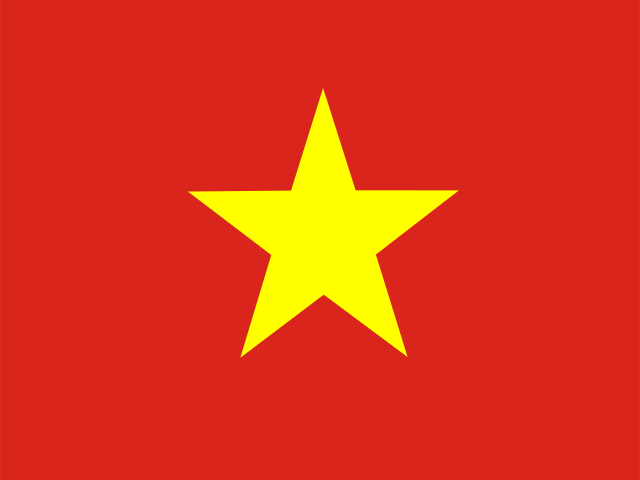
Vietnam38/100
“Two nations united by two wheels and divided by everything else, including whether those wheels obey traffic signals.”
Breakdown & sources
Work-Life Balance42
The Dutch engineer their leisure with the same precision they bring to cycle infrastructure; the Vietnamese treat the boundary between work and life as an advisory, not a rule.
Hierarchy & Formality30
The Netherlands removed deference from its operating system several decades ago, while Vietnam runs on a hierarchy so structurally load-bearing that dismantling it would require planning permission.
Communication Style33
Dutch directness — the kind that makes a performance review feel like a traffic citation — meets Vietnamese indirectness, which communicates volumes through what is carefully not said.
Punctuality Culture45
The Dutch arrive on time because the infrastructure demands it; the Vietnamese arrive when the collective flow of traffic, commerce, and social obligation delivers them, which is a different but internally consistent system.
Social Bonding41
Both cultures bond efficiently over shared mobility — one over a craft beer at a terrace reached by bicycle, the other over a plastic stool and a bowl of phở reached by motorbike, and the outcomes are warmer than the methods suggest.
India38/100
“A meeting of two countries that have both, in their own way, solved the problem of daily life — one through bureaucratic infrastructure and the other through family infrastructure — and will spend considerable time explaining to each other why their solution is obviously correct.”
Breakdown & sources
Work-Life Balance35
The Netherlands legislates boundaries between work and personal time with the same enthusiasm India deploys family obligations to dissolve them entirely.
Hierarchy & Formality30
Dutch directness and flat organisational structures will strike the Indian professional as either refreshingly honest or professionally alarming, depending entirely on what their manager just said.
Communication Style28
One culture treats bluntness as a courtesy and the other treats indirectness as one, leaving both parties convinced the other is being either rude or evasive.
Punctuality Culture25
Dutch diaries, per the publication's own reporting, are scheduled to the minute including informal dinners — a concept that in India would be categorised under speculative fiction.
Social Bonding45
Both cultures take hospitality seriously, though one expresses it through a warm home-cooked meal for twelve unannounced relatives and the other through a calendar invite sent four weeks in advance.
Indonesia34/100
“A nation that has philosophically accepted that time is a suggestion meets a nation that has weaponised punctuality and attached it to a bicycle bell — the resulting collision is, fittingly, a traffic incident.”
Breakdown & sources
Work-Life Balance38
Indonesians spend their leisure time sitting in traffic contemplating leisure, while the Dutch aggressively cycle home at 5pm sharp — both are suffering, just on different schedules.
Hierarchy & Formality30
One culture has refined the art of deferential patience through ninety-minute gridlock; the other will ring a bell at a senior colleague and feel entirely justified.
Communication Style28
The Dutch deliver feedback with the directness of a tram that does not yield to physics, while Indonesians have perfected the art of the warm, non-committal reply — these are not compatible operating systems.
Punctuality Culture18
Jakarta treats an ETA as a opening bid in a negotiation with rainfall, while Amsterdam treats a two-minute delay as a personal moral failing — a pairing that will satisfy no one and enrage at least one party.
Social Bonding52
Both cultures have developed rich survival rituals around their commutes — Indonesians bond over shared Gojek horror stories, the Dutch over stolen bicycle eulogies — and this, at least, is common ground.

Kyrgyzstan31/100
“A country that treats bus schedules as spiritual suggestions has been paired with one that has codified the correct arm angle for a left turn — and somehow, neither is wrong, which is exactly the problem.”
Breakdown & sources
Work-Life Balance38
Kyrgyzstan's relationship with time is more of an open arrangement, while the Netherlands treats leisure with the same rigorous efficiency it applies to everything else — both unwind, but one does it on a schedule.
Hierarchy & Formality29
A culture where the driver simultaneously operates the vehicle, collects fares, and arbitrates passenger disputes from a position of unchallenged authority is structurally incompatible with Dutch radical egalitarianism.
Communication Style35
Shouting 'Ostanovka!' out of a moving minibus and receiving a silent, withering Dutch tut for cycling too slowly in the fast lane are both forms of communication — they are simply not the same form.
Punctuality Culture12
The Netherlands runs trams; Kyrgyzstan runs marshrutkas that leave when the driver has decided, philosophically, that enough people are present — these are not compatible ontologies of time.
Social Bonding42
Being pressed against five strangers past rated capacity in a Soviet minibus and being silently judged by a grandmother on a cargo bike are both intimate experiences, just not the kind either country would recognise as such.
Uganda31/100
“Two nations united by the conviction that you are probably fine, divided by everything else — including whether 'probably fine' is a philosophy or a budget constraint.”
Breakdown & sources
Work-Life Balance35
The Dutch have institutionalised the right to switch off; Ugandans have institutionalised the reality that switching off is a luxury the infrastructure may not permit.
Hierarchy & Formality28
Uganda's deference to seniority and Uganda's private-care VIP warmth sit at a polite but unbridgeable distance from Dutch egalitarianism, which treats the consultant and the cleaner with the same brisk efficiency.
Communication Style30
The Dutch will tell you directly that your symptoms are unimpressive; Ugandans will tell you warmly and at length that they will see to you immediately — two very different ways of delivering news, neither of which prepares you for the other.
Punctuality Culture25
A Dutch appointment begins at the stated time and ends four minutes later; a Ugandan private consultation begins when care is ready, which could be now, or could be a concept.
Social Bonding38
Ugandan hospitality is personal, immediate, and warmly enveloping; Dutch hospitality is scheduled three weeks in advance and comes with an agenda.
South Korea31/100
“Two countries that have both perfected the art of making you feel unwelcome — one through devastating silence, one through devastating honesty — and have absolutely nothing else in common.”
Breakdown & sources
Work-Life Balance38
The Dutch treat leisure as a constitutional right; South Korea treats its absence as a professional credential.
Hierarchy & Formality15
One culture has spent centuries encoding deference into every bow, glance, and two-handed object transfer; the other considers unsolicited egalitarianism a form of basic courtesy.
Communication Style12
South Korea disapproves of you in total, weaponised silence; the Netherlands will explain your failure out loud, in detail, mid-cycle-lane — both approaches are efficient, and neither is survivable by the other country's standards.
Punctuality Culture52
The only dimension where détente is possible: both nations take showing up seriously, even if one does so because efficiency is a virtue and the other because being late would require someone to acknowledge it.
Social Bonding29
Korean bonding rituals are elaborate, hierarchical, and unspoken; Dutch ones are blunt, flat, and egalitarian — a pairing that risks each side concluding the other is either dangerously rude or pathologically indirect.
Philippines28/100
“A country that splits the bill on the first date meets a country that expects to meet your mother before the second — compatibility, like the check, remains deeply contested.”
Breakdown & sources
Work-Life Balance40
The Dutch treat leisure as a constitutional right; Filipinos treat family obligation as one — both prioritise life over work, but define 'life' in ways that would confuse the other entirely.
Hierarchy & Formality20
The Netherlands has largely abolished deference as a social category, while the Philippines has elevated it into an art form that begins at the dinner table and ends nowhere visible.
Communication Style15
Dutch directness — deployed cheerfully and without apology — lands in Filipino social culture roughly the way a foghorn lands in a library.
Punctuality Culture38
The Dutch arrive on time because lateness is a form of disrespect; Filipinos operate on a more forgiving temporal philosophy that treats schedules as optimistic suggestions.
Social Bonding22
One culture bonds over a gezellig bike ride and a correctly itemised dinner bill; the other bonds through extended family interrogation and generational patience — both are sincere, neither is translatable.