← Compatibility Index
 Norway
Ranked against every country we've compared Norway to, highest compatibility first.
Uruguay62/100
“Two nations that have independently concluded the correct response to weather — however dramatic or mild — is to build an elaborate indoor ritual around it and call it a personality.”
Breakdown & sources
Work-Life Balance65
Norway legislates rest into the calendar with Scandinavian precision; Uruguay arrives at roughly the same destination via asado, mate, and an unspoken cultural consensus that the afternoon belongs to no one in particular.
Hierarchy & Formality60
Both countries trend informal by global standards, though Norway's flatness is an institutional achievement and Uruguay's is simply what happens when everyone is busy passing a gourd.
Communication Style58
Norwegians communicate with the economy of people conserving warmth, while Uruguayans communicate with the unhurried expansiveness of people who brought a thermos and are not leaving soon.
Punctuality Culture52
Norway runs on time because polar darkness waits for no one; Uruguay checks the forecast obsessively yet still operates on a schedule best described as 'the mate will be ready when it's ready.'
Social Bonding72
Shared rituals of endurance — koselig for one, the communal gourd for the other — mean both cultures have independently invented the same answer to social cohesion: sit down, something warm is coming.
Japan52/100
“Two punctuality cults that have agreed on exactly one thing and chosen to spend the remaining cultural square footage as far apart as the Arctic and the Pacific will allow.”
Breakdown & sources
Work-Life Balance38
Japan's salaryman doing calf raises at 2am and Norway's colleague whose 'quick walk' becomes 12km are both suffering, just in completely incompatible directions.
Hierarchy & Formality34
Japan has engineered anticipatory deference into a structural philosophy; Norway has engineered it out entirely, possibly by mistake, possibly on purpose.
Communication Style41
Japan communicates in ceremony, omotenashi, and meaningful silence; Norway communicates in transactional brevity and the sigh of a cashier who has heard your price complaint before and will hear it again.
Punctuality Culture88
The one dimension on which both nations have independently concluded that a late bus is a moral failure — a rare and precious alliance between two peoples who agree on almost nothing else.
Social Bonding36
Norwegians bond through shared outdoor suffering in horizontal sleet; Japanese bond through structured group calisthenics in parks at dawn — both deeply communal, both deeply resistant to the casual stranger.

Thailand42/100
“A nation that has philosophically accepted darkness and a nation that has philosophically accepted being cooked alive have, against all odds, reached the same conclusion — that complaining about it is beside the point — which is perhaps the only thing they will ever agree on.”
Breakdown & sources
Work-Life Balance50
Both cultures have negotiated a truce with their respective climates by structuring daily life around them — Thailand via the afternoon retreat, Norway via the cosy indoor evening — arriving at work-life balance through entirely incompatible meteorological emergencies.
Hierarchy & Formality38
The articles do not dwell on this dimension, which is itself informative: Norway's egalitarian flatness and Thailand's deeply hierarchical social architecture are sufficiently divergent that no shared weather philosophy can paper over them.
Communication Style44
Norwegians consider complaining about winter unimaginative; Thais consider visible distress about heat impolite — both cultures have converged on stoic non-complaint through entirely different emotional routes, which is compatibility of output rather than input.
Punctuality Culture40
Thai timing is organised around the sun's lethality; Norwegian timing is organised around the sun's absence — two scheduling philosophies that share a celestial obsession and almost no practical overlap.
Social Bonding45
Norway bonds over friluftsliv and stocked kitchens against the dark; Thailand bonds over the shared, largely unspoken acknowledgment that April will try to kill you — both are perfectly valid foundations for human solidarity, and neither translates to the other's climate.
Singapore41/100
“Two nations that have both 'solved' the natural world — one by submitting to it entirely, one by filing the paperwork — and whose populations have consequently developed such different instincts for spontaneity, control, and the appropriate use of a Tuesday that meaningful workplace harmony will require patience, good faith, and possibly a mediating spreadsheet.”
Breakdown & sources
Work-Life Balance38
Norway treats the hytte weekend as social infrastructure; Singapore treats the weekend as an opportunity to optimise a park visit before humidity ruins it — both are leisure, technically, but one was planned by a person and the other by a National Parks Board.
Hierarchy & Formality44
Singapore's five-year plans and finable offences suggest a culture that trusts systems over individuals, while Norway's allemannsretten — a legal right to camp in a stranger's backyard — implies a society operating on rather more horizontal assumptions.
Communication Style47
Singapore delivers abundance with the quiet confidence of a nation that colour-coded its trees before planting them; Norway delivers honesty with the quiet confidence of a nation that never felt the need to plant them at all.
Punctuality Culture52
Singapore's covered linkway network exists precisely so that nothing — not rain, not heat, not the chaos of nature — can make you late; Norway simply notes that if the trail offers only a rope and a cairn, you should have left earlier.
Social Bonding33
In Norway, the highest social invitation is a cabin weekend in the dark; in Singapore, it is the discovery of a good hawker stall before the lunchtime queue forms — both are sincere, but one assumes you own waterproof trousers.
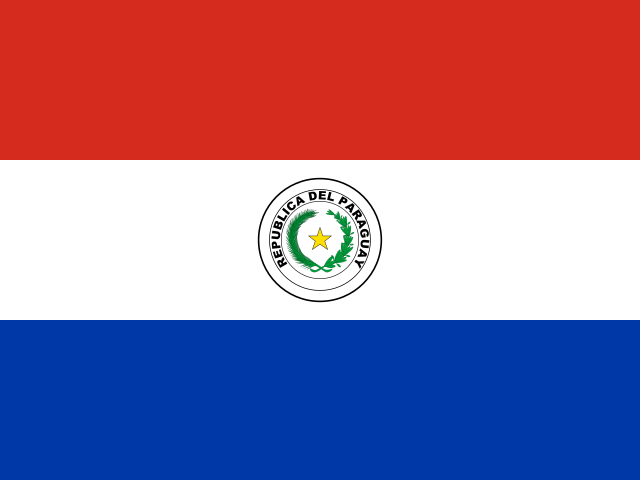
Paraguay38/100
“Two cultures united by a single shared value — linguistic humility — and divided by almost everything else, including how they achieve it.”
Breakdown & sources
Work-Life Balance35
Norway has institutionalised the boundary between work and life; Paraguay treats that boundary as a suggestion, if it has heard of it at all.
Hierarchy & Formality40
Paraguay's layered colonial formality and Norway's studied egalitarianism occupy the same planet only in the loosest geographical sense.
Communication Style42
Paraguay will speak two languages at you without warning; Norway will speak your language back at you so fluently it constitutes a quiet reproach — different methods, identical humbling outcomes.
Punctuality Culture30
One culture treats a stated meeting time as a loose aspiration; the other treats it as a minor moral commitment, and neither will say so directly.
Social Bonding43
Paraguayans warm to you the moment you mispronounce a Guaraní greeting; Norwegians will politely admire your English indefinitely and call it friendship.
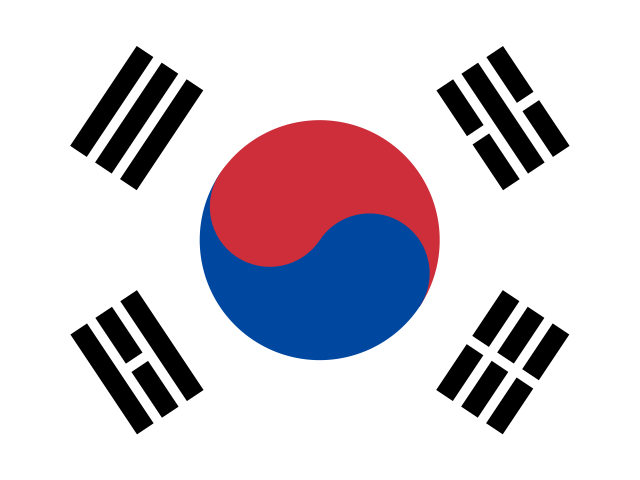
South Korea34/100
“Two countries that will both destroy you physically and expect a smile about it, but have agreed on absolutely nothing else.”
Breakdown & sources
Work-Life Balance28
Norway treats leisure as a constitutional right enforced by weather; South Korea treats it as a performance metric with quarterly reviews.
Hierarchy & Formality30
The Norwegian stranger handing you coffee assumes equality; the Seoul trainer sizing you up in four seconds has already ranked you.
Communication Style38
Norwegians communicate through companionable silence on a mountainside; South Koreans communicate through unsolicited staff intervention before you've touched a machine.
Punctuality Culture45
Both cultures will judge you for being late to the mountain, but only one has scheduled the judgment into a spreadsheet.
Social Bonding36
Shared suffering is the common language — Norwegian sleet or Seoul jjimjilbang — but one side considers nudity mandatory and the other considers it a criminal personality flaw.
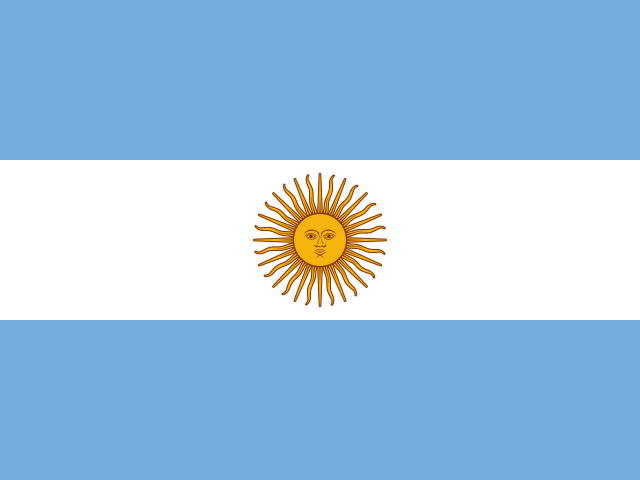
Argentina34/100
“Two countries that have both perfected the art of social interaction — one by doing it constantly, loudly, and with strong opinions about your tomatoes; the other by engineering it out of existence entirely.”
Breakdown & sources
Work-Life Balance38
Argentina treats daily life as a series of relationships to be maintained under economic duress; Norway treats it as a series of transactions to be completed efficiently so you can get back to being alone outdoors.
Hierarchy & Formality42
Argentina's warmth collapses formality immediately — your butcher has opinions about your life choices — while Norway's equality ethic keeps everyone at a politely horizontal, frictionlessly distant arm's length.
Communication Style22
One country communicates in porteño Spanish at auctioneer velocity with Lunfardo flourishes; the other communicates in flawless English while quietly hoping you'll stop talking so they can scan the next item.
Punctuality Culture35
Norway's cashiers maintain a scanning speed; Argentina's cashiers are mid-conversation about the exchange rate and will get to you when they get to you.
Social Bonding28
Argentina bonds through daily negotiation, loyalty, and the shared trauma of inflation; Norway bonds through the mutual understanding that the self-checkout machine requires no small talk and everyone prefers it that way.
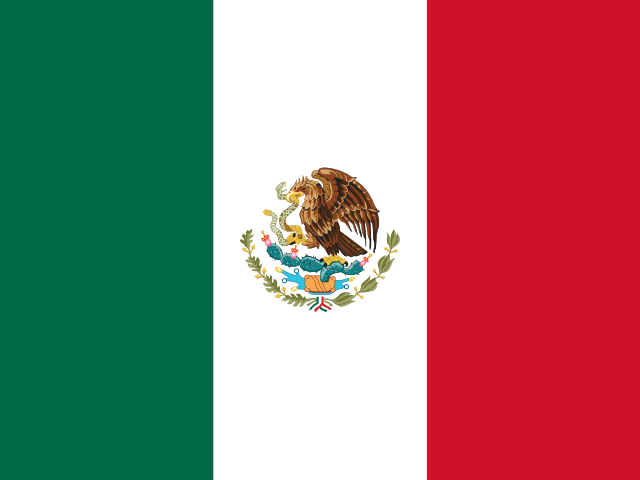
Mexico34/100
“Two nations who have looked at the concept of 'a nice time' and arrived at conclusions so opposite that one suspects they have never once consulted a map of the same planet.”
Breakdown & sources
Work-Life Balance38
Mexico sends a man with a frozen drink to your deckchair; Norway sends you to an outhouse in February and calls it restorative — both are sincere, which is somehow the most alarming part.
Hierarchy & Formality42
Mexico greets you as 'amigo' and means it warmly; Norway greets you with a DNT logbook and means it structurally — intimacy and distance, each with impeccable internal logic.
Communication Style30
One culture deploys attentive warmth as a default frequency; the other considers ringing reception twice in one evening a documented social incident.
Punctuality Culture45
Mexico rewards the organised resort-goer who books at dawn, while Norway enforces the honour system with a seriousness that suggests the hytte cabin log is a binding legal instrument.
Social Bonding22
An invitation to a Norwegian hytte is the highest honour the country grants, which is deeply moving right up until you realise it involves splitting logs in silence forty kilometres from a bar.
Costa Rica34/100
“A nation that treats the 7:42 as a sacred covenant meets a nation that treats 'around noon' as a binding contract — compatibility is theoretically possible, in the same way that jazz and a metronome are theoretically compatible.”
Breakdown & sources
Work-Life Balance48
Both countries have a healthy suspicion of working yourself to death, but one expresses this through structured leisure and the other through a philosophical shrug at the very concept of structure.
Hierarchy & Formality52
Norway's egalitarian flatness and Costa Rica's warm informality arrive at similar social destinations by completely different roads — one paved, timed, and lit; the other scenic and approximate.
Communication Style40
Norwegians communicate on the T-bane by making sustained, meaningful eye contact with their shoes, while Costa Ricans will cheerfully ask a mango vendor for life advice — a gap that is charming until it is exhausting.
Punctuality Culture11
One country built an app so its citizens could confirm, to the second, that the universe is behaving correctly; the other country considers 'it comes when it comes' a perfectly complete answer to a scheduling question.
Social Bonding38
Costa Ricans befriend their bus driver as a survival strategy; Norwegians regard making small talk with a stranger on public transport roughly as they would regard removing a stranger's shoes.
Vietnam31/100
“Two countries that have each perfected public life — one by filling every available silence, the other by legislating against it — and whose citizens will spend their entire shared visit being either overwhelmed or mildly appalled.”
Breakdown & sources
Work-Life Balance45
Insufficient data to score confidently, though a country where street activity continues well into the evening and a country where you disappear into collective quiet presumably disagree on what 'after work' even means.
Hierarchy & Formality40
Insufficient direct reporting, but a culture built on Jantelov's insistence that no one is special and a culture of cheerful collective negotiation are at least arriving at egalitarianism from entirely opposite emotional directions.
Communication Style22
Vietnam treats public space as an ongoing, ambient, high-volume conversation with strangers; Norway treats the same scenario as a contractual obligation to remain undetectable.
Punctuality Culture38
A country where queues are 'more of a general suggestion' and a country with numbered ticket systems in small shops are not, strictly speaking, operating the same theory of time.
Social Bonding24
Vietnam bonds through cheerful proximity and trusted chaos; Norway bonds by carefully not sitting next to you on an otherwise empty bus — both approaches work, but not simultaneously.
Philippines28/100
“One country treats romance as a cryptic solo hike best completed in silence; the other deploys the extended family as a welcoming committee before the appetizers arrive — compatibility exists, technically, in the same way that a monastery and a fiesta exist on the same planet.”
Breakdown & sources
Work-Life Balance42
Norway guards private time with the zeal of a border control agent, while the Philippines folds work, family, and social obligation into one seamless, never-ending occasion — both value life outside the office, but they disagree fundamentally on whether that life should be quiet or crowded.
Hierarchy & Formality30
Norway's egalitarian instinct insists everyone split the bill and no one bow to anyone, while the Philippines expects visible, sincere deference to elders and parents from the first forty minutes of acquaintance — one culture flattens hierarchy on principle, the other builds its social architecture entirely upon it.
Communication Style15
The Norwegian communication style is a summit reached after three hours of silence and rewarded with the phrase 'this was nice,' whereas Filipino courtship is a semi-public declaration performed before a live studio audience of aunts — these are not merely different dialects but different theories of what language is for.
Punctuality Culture48
The articles offer no direct evidence on punctuality, but a culture that plans wedding menus forty minutes into a first introduction and one that requires six months of silence before commitment are, at minimum, operating on incompatible clocks.
Social Bonding12
Norway bonds through shared restraint, mutual independence, and the quiet dignity of not asking too much of anyone, while the Philippines bonds by immediately making you a group project involving two aunts, a catering plan, and the collective emotional investment of an entire extended family — the gap here is not a gap so much as a chasm with a rope bridge.