← Compatibility Index
 Argentina
Ranked against every country we've compared Argentina to, highest compatibility first.

Turkey72/100
“Two countries that have never met a stranger, never respected a queue, and will absolutely feed you until you submit — a compatibility born less of similarity than of shared refusal to let social awkwardness exist unchallenged.”
Breakdown & sources
Work-Life Balance68
Neither country has been formally accused of leaving the office early, but Argentina's elastic relationship with start times and Turkey's tea-enforced pause culture suggest a shared philosophical suspicion of rigid scheduling.
Hierarchy & Formality65
Turkey performs its hierarchy visibly — elders are stood for, hands are kissed — while Argentina's cheek-kiss-for-everyone ethos flattens the room instantly, which is either refreshingly egalitarian or a mild cardiac event for visiting Turks.
Communication Style78
Both nations communicate at a volume and passion that foreigners routinely mistake for a crisis, so at least when an Argentine and a Turk argue about nothing, neither will call the authorities.
Punctuality Culture74
Argentina treats punctuality as a social faux pas and Turkey treats queues as a loose conceptual framework, so both parties will arrive somewhere in the general vicinity of when they said they would and consider the matter closed.
Social Bonding81
Mate-sharing and çay-refusing are equally non-negotiable rituals of forced intimacy, meaning both cultures will have made you family before you've learned anyone's last name.

South Africa72/100
“Two nations that have independently concluded the highest form of civilisation is standing near fire for several hours arguing about it — compatible in spirit, incompatible in punctuality.”
Breakdown & sources
Work-Life Balance68
Both cultures treat the weekend as a serious, non-negotiable institution; they differ mainly on whether 'starting on time' is a component of leisure or an affront to it.
Hierarchy & Formality74
Each country has designated one person — the asador, the braai master — with unquestioned dominion over fire, which suggests a surprisingly compatible theory of informal authority.
Communication Style78
Argentina offers cheerful, overlapping, affectionate argument; South Africa offers cheerful, concurrent, coal-based argument — a distinction real enough to matter, too small to be fatal.
Punctuality Culture55
South Africans arrive on time to stand around a fire for four hours; Argentines arrive late to stand around a fire for four hours — a philosophical difference masquerading as a logistical one.
Social Bonding88
Both nations have independently enshrined 'prolonged proximity to grilled meat with people you didn't choose' as the correct unit of human connection, which is about as compatible as two cultures can get.

Ireland62/100
“Two countries that have both made peace with economic disappointment, though Argentina haggles with the void while Ireland merely mourns it quietly over a pint.”
Breakdown & sources
Work-Life Balance60
Both cultures have learned to cope with systems that don't quite work — Argentina through improvisation, Ireland through quiet acceptance — which is either deep compatibility or shared resignation.
Hierarchy & Formality65
Neither country is particularly stiff about rank, though Argentina's informal dual-currency economy suggests a people who have long since stopped pretending institutions are in charge.
Communication Style70
The Argentine market vendor repricing mid-conversation and the Irish shopkeeper apologising for closing early are, at heart, both people softening bad news with considerable charm.
Punctuality Culture58
Argentina treats time as approximate; Ireland treats shop hours as aspirational — a pairing that will frustrate no one and delight anyone who brought a book.
Social Bonding72
The Buenos Aires feria and the Dublin market share the same stubborn communal warmth, both operating as social institutions that the economy keeps trying, and failing, to extinguish.

China38/100
“Two nations united by a profound seriousness about food and an equally profound inability to agree on how time, hierarchy, or a supermarket queue should function.”
Breakdown & sources
Work-Life Balance35
China's algorithmically optimised everything-at-all-hours culture and Argentina's ongoing negotiation with closing times are compatible only in the sense that neither country has fully solved the problem.
Hierarchy & Formality32
China's precisely ordered grocery bagging and Argentina's leisurely checkout queue suggest two societies with very different views on who is in charge and why it matters.
Communication Style45
Both cultures will tell you exactly what you are doing wrong — the Chinese wet market vendor and the Argentine butcher are, spiritually, the same person — but one expects you to already know and the other finds your ignorance charming.
Punctuality Culture28
A country where the wet market operates at peak efficiency by 7am and a country where Sunday afternoon shopping is a philosophical gamble are not, by any reasonable measure, on the same clock.
Social Bonding52
The shared conviction that food is not merely sustenance but a moral position provides genuine common ground, even if the WeChat Pay receipt and the small-bills-in-hand experience represent irreconcilable visions of modernity.
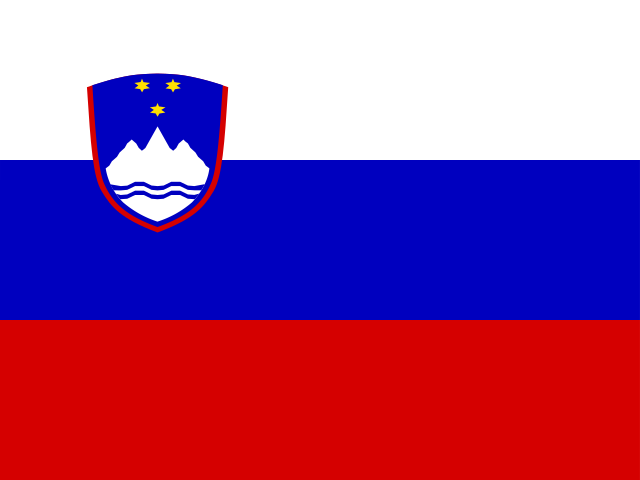
Slovenia38/100
“Two cultures that both prize deep intimacy have simply agreed, without consulting each other, on completely opposite ways of getting there.”
Breakdown & sources
Work-Life Balance52
Both nations guard their personal lives with conviction, though one does so by leaving the office on time and the other by staying out until 3am.
Hierarchy & Formality45
Slovenia's reserved, structured social architecture and Argentina's warm but unspoken code of conduct are both rule-governed systems — just rules written in different languages.
Communication Style22
The Slovenian strategy of saying little until trust is earned meets the Argentine strategy of communicating an entire emotional autobiography through a cheek kiss — compatibility here is theoretical at best.
Punctuality Culture48
Slovenia arrives when it says it will; Argentina arrives when the evening feels ready — a distinction that sounds minor until you have been waiting at a milonga for ninety minutes.
Social Bonding21
One culture requires months of quiet, incremental presence before granting access to its inner circle; the other requires only eye contact and a nod, which is either refreshingly efficient or deeply alarming depending on which side of this article you grew up on.

Belarus34/100
“A country that kisses strangers within ninety seconds meets a country that requires six meetings to confirm you exist — the resulting compatibility score is, predictably, not high.”
Breakdown & sources
Work-Life Balance45
Argentines extend asados into the small hours as a matter of principle; Belarusians prefer their leisure deliberate and bounded — both value time away from work, but they would spend it together in a state of mutual bewilderment.
Hierarchy & Formality40
Belarus treats formality as a structural necessity and politeness as a distinct category from friendship, while Argentina treats both as optional obstacles on the way to being on a first-name basis at the appetiser course.
Communication Style22
Argentina communicates at volume, with passion, gestures, and cheek contact before a sentence is finished; Belarus considers an unrequested smile from a stranger an act of mild social aggression.
Punctuality Culture38
Arriving fashionably late to an Argentine gathering is a social courtesy; one suspects a Belarusian guest would be standing outside, punctual and slightly offended, for forty-five minutes before the host arrived.
Social Bonding25
Argentina bonds instantly and loudly over mate and meat; Belarus bonds slowly, sincerely, and only after a vetting process that would not embarrass a mid-tier intelligence service.
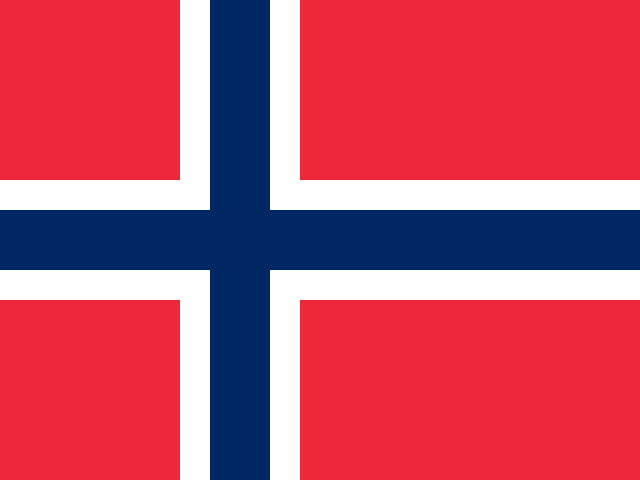
Norway34/100
“Two countries that have both perfected the art of social interaction — one by doing it constantly, loudly, and with strong opinions about your tomatoes; the other by engineering it out of existence entirely.”
Breakdown & sources
Work-Life Balance38
Argentina treats daily life as a series of relationships to be maintained under economic duress; Norway treats it as a series of transactions to be completed efficiently so you can get back to being alone outdoors.
Hierarchy & Formality42
Argentina's warmth collapses formality immediately — your butcher has opinions about your life choices — while Norway's equality ethic keeps everyone at a politely horizontal, frictionlessly distant arm's length.
Communication Style22
One country communicates in porteño Spanish at auctioneer velocity with Lunfardo flourishes; the other communicates in flawless English while quietly hoping you'll stop talking so they can scan the next item.
Punctuality Culture35
Norway's cashiers maintain a scanning speed; Argentina's cashiers are mid-conversation about the exchange rate and will get to you when they get to you.
Social Bonding28
Argentina bonds through daily negotiation, loyalty, and the shared trauma of inflation; Norway bonds through the mutual understanding that the self-checkout machine requires no small talk and everyone prefers it that way.
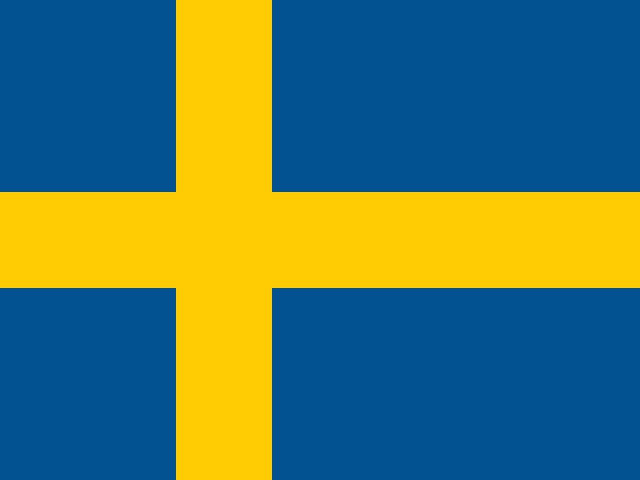
Sweden34/100
“A nation that invented the deniable coffee date meets a nation that invented the 2am declaration of eternal love — compatibility is theoretically possible, in the same way that filing a joint tax return with someone you met during a blackout is theoretically possible.”
Breakdown & sources
Work-Life Balance38
Sweden clocks off at five with the quiet satisfaction of a person who has read the manual; Argentina clocks off when the conversation dies, which is usually closer to dawn.
Hierarchy & Formality45
Both countries have, in their own ways, abolished the handshake — Sweden out of egalitarian instinct, Argentina out of sheer warmth — but the resulting atmospheres could not be more different rooms.
Communication Style18
Sweden communicates feelings the way a glacier communicates urgency; Argentina communicates feelings the way a car alarm communicates parking violations — constantly, at volume, and whether or not anyone asked.
Punctuality Culture30
Swedes arrive on time because lateness implies disrespect; Argentines arrive late because 9pm means 10:15 and codifying this any further would ruin the mystique.
Social Bonding22
Swedes bond through scheduled club memberships and calibrated ambiguity; Argentines bond through psychoanalysis, midnight dinners, and cheek kisses administered to people whose surnames they will never learn.

Germany34/100
“A country that invents long weekends by decree meets a country that legislates silence on them — compatibility exists mainly in the shared acknowledgment that holidays are, technically, days.”
Breakdown & sources
Work-Life Balance38
Argentina engineers leisure through bureaucratic improvisation; Germany engineers it through regional statute — both arrive at time off, but via routes so different they would never carpool.
Hierarchy & Formality42
Insufficient data from the articles to score precisely, though a culture that governs holiday noise by law and one that moves holidays by casual decree are clearly operating from different constitutional temperaments.
Communication Style40
Argentina announces a puente with breezy administrative confidence; Germany publishes a state-specific calendar and expects you to have consulted it — one communicates in vibes, the other in spreadsheets.
Punctuality Culture22
A nation that moves the date of a holiday at will and a nation that legally enforces quiet hours are not, broadly speaking, synchronized.
Social Bonding35
Argentina bonds over spontaneous asado and mate regardless of the occasion; Germany bonds over Christmas markets and regional tradition on a fixed, pre-approved schedule — warmth is present in both, but the calendar invitations would never arrive on the same day.

Switzerland28/100
“A country that treats its currency as a daily adventure meets one that has not revised its banking procedures since the invention of the cuckoo clock — compatibility, like the official Argentine exchange rate, is largely theoretical.”
Breakdown & sources
Work-Life Balance42
Both cultures prize living well outside the office, though one does so by philosophical conviction and the other by sheer necessity when the economy makes long-term planning an act of magical realism.
Hierarchy & Formality22
Switzerland's counter staff operate on procedure, not personality; Argentina's financial system operates on personal relationships with a man named Marcelo — these are not the same org chart.
Communication Style30
Argentines navigate financial reality through WhatsApp groups and improvised trust networks; the Swiss prefer formal documentation and a ninety-minute appointment, which is, admittedly, also a form of communication.
Punctuality Culture18
In Switzerland, missed deadlines escalate formally and swiftly; in Argentina, prices do not hold steady for more than a few weeks, suggesting that deadlines themselves are a somewhat optimistic concept.
Social Bonding35
Argentina bonds over shared improvisation and hard-won informal networks; Switzerland bonds over the quiet satisfaction of a correctly filed QR-bill — both are genuine, and they will never fully understand each other.