← Compatibility Index
 Ireland
Ranked against every country we've compared Ireland to, highest compatibility first.
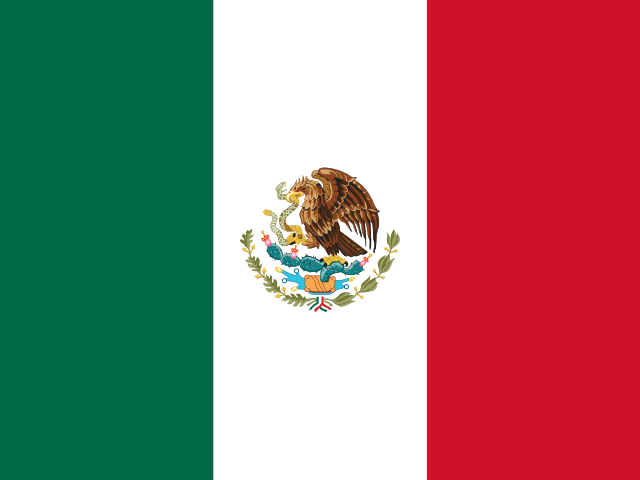
Mexico68/100
“Two nations that have independently concluded life is too short to be sober at a funeral, separated chiefly by their attitude toward what time the party is supposed to start.”
Breakdown & sources
Work-Life Balance72
Mexico schedules entire months as officially unavailable for commerce, while Ireland invented a national holiday the Irish themselves were too holy to enjoy — both, in their way, have made peace with the idea that work is the interruption.
Hierarchy & Formality61
Mexico's festival calendar answers to saints, virgins, and the revolution; Ireland's answers to the parish and the publican — neither country is exactly flat, but neither expects you to book a meeting with the Virgin of Guadalupe two weeks in advance.
Communication Style74
Both cultures have mastered the art of the correction that doesn't feel like a correction — the Mexican who patiently dismantles your Halloween analogy and the Irishman who watches Chicago dye its river green without saying a word are operating from the same emotional frequency.
Punctuality Culture55
Mexico has formally enshrined lateness by advising visitors that any event ending in '-ada' arrives when it arrives; Ireland, having spent most of its national holiday at mass, at least has a theological excuse for the delay.
Social Bonding81
One country invites its dead to dinner and calls it a party; the other turned a quiet religious observance into the world's most franchised pub crawl — as frameworks for human togetherness go, both are doing considerably more than the minimum.
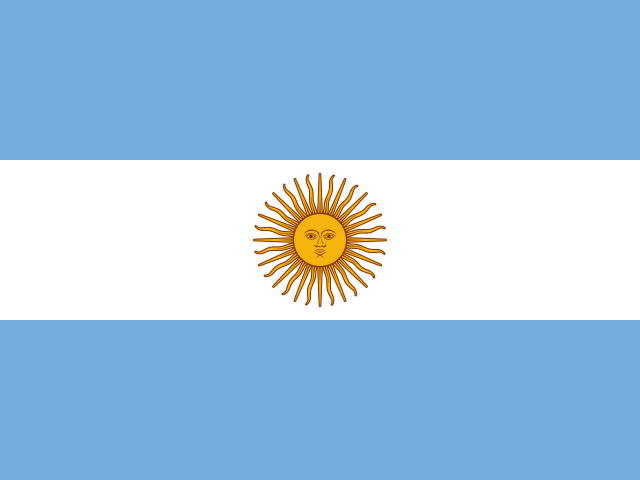
Argentina62/100
“Two countries that have both made peace with economic disappointment, though Argentina haggles with the void while Ireland merely mourns it quietly over a pint.”
Breakdown & sources
Work-Life Balance60
Both cultures have learned to cope with systems that don't quite work — Argentina through improvisation, Ireland through quiet acceptance — which is either deep compatibility or shared resignation.
Hierarchy & Formality65
Neither country is particularly stiff about rank, though Argentina's informal dual-currency economy suggests a people who have long since stopped pretending institutions are in charge.
Communication Style70
The Argentine market vendor repricing mid-conversation and the Irish shopkeeper apologising for closing early are, at heart, both people softening bad news with considerable charm.
Punctuality Culture58
Argentina treats time as approximate; Ireland treats shop hours as aspirational — a pairing that will frustrate no one and delight anyone who brought a book.
Social Bonding72
The Buenos Aires feria and the Dublin market share the same stubborn communal warmth, both operating as social institutions that the economy keeps trying, and failing, to extinguish.
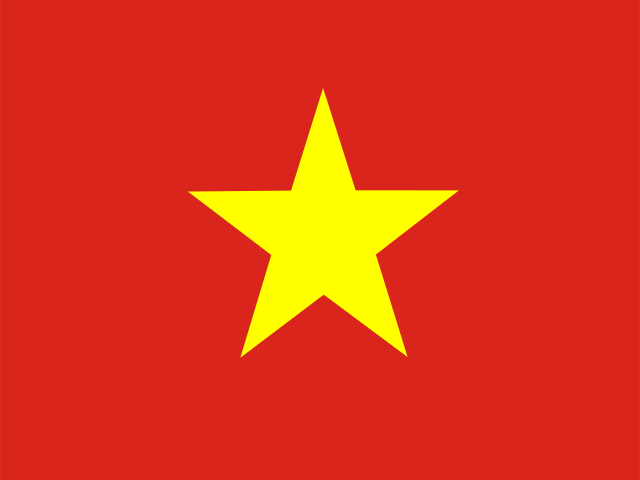
Vietnam62/100
“Two nations that have independently solved the problem of human connection — one via a dimly lit room with Guinness on tap, the other via the pavement itself — and will get along splendidly once they agree the venue is irrelevant.”
Breakdown & sources
Work-Life Balance60
The published articles don't venture into the office, but both cultures demonstrably believe life happens outside of it — one at the pub, one on the kerb, both emphatically not at a desk.
Hierarchy & Formality55
Vietnam's neighbourhood administrative structures carry real weight and demand acknowledgement; Ireland's equivalent authority is the publican, whose power is moral rather than bureaucratic.
Communication Style65
Irish slagging and Vietnamese neighbourly commentary are both forms of uninvited social observation — the Irish just package theirs as a joke and expect you to laugh.
Punctuality Culture58
Neither culture, as reported, appears to be scheduling its community life — the Irish pub works on a drop-in basis, and the Vietnamese pavement stool is simply always there, which is either very compatible or a recipe for two cultures perpetually waiting for each other to arrive.
Social Bonding72
Both countries have independently arrived at the same conclusion — that belonging is built through small, repeated, low-stakes contact — and merely disagree on whether fruit over a wall or banter over a pint is the superior delivery mechanism.
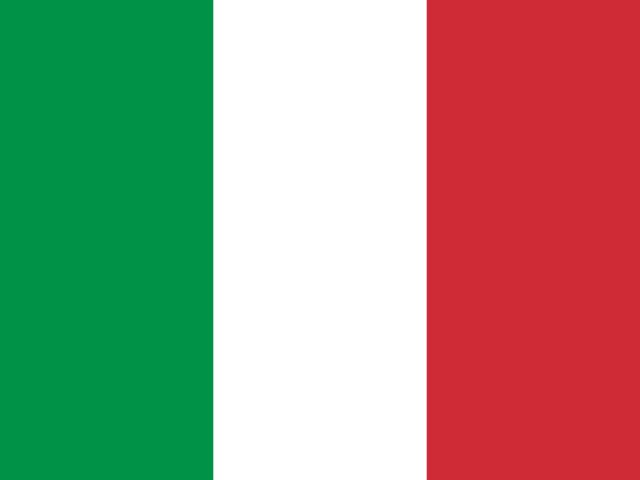
Italy62/100
“A partnership between a culture that expresses love through ritualized mockery and one that expresses it through baroque soliloquy — theoretically complementary, until the Irish person realises the compliment was genuine and the Italian realises the insult was affectionate, at which point both will require several drinks to process.”
Breakdown & sources
Work-Life Balance65
Both nations have elevated the extended social evening to something approaching a civic duty, though one conducts it in a pub with ironic detachment and the other conducts it on a cobblestone street with architectural eye contact.
Hierarchy & Formality55
Italy's binding matriarchal hierarchy — in which Mamma's verdict is final and the family table is a constitutional document — finds no real equivalent in Ireland, where authority is mostly something you take the mick out of.
Communication Style38
One country has industrialised indirection into a national art form; the other will have told you its feelings, its intentions, and possibly its bloodline within ninety seconds — a gap so wide it constitutes a different operating system.
Punctuality Culture70
Neither culture has staked its national identity on arriving at the agreed hour, which is perhaps the single most structurally compatible thing about them.
Social Bonding72
The Irish pub round and the Italian passeggiata are, at their core, the same technology — a group ritual that does the emotional labour no individual in either country is prepared to do alone.
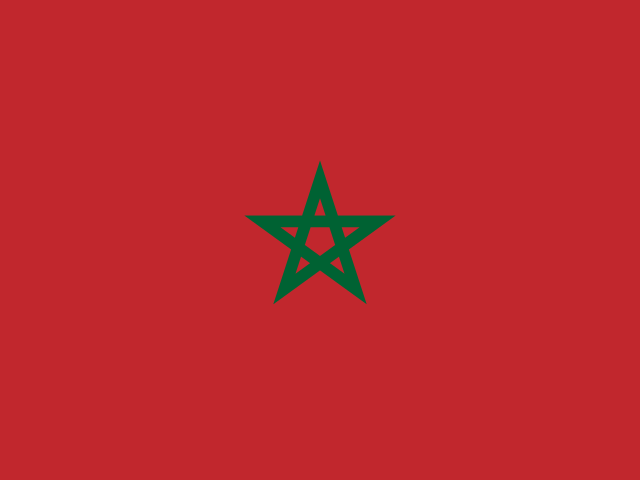
Morocco52/100
“Two nations that both believe in the sacred importance of community, provided you understand that one will adopt you within the week and the other will acknowledge your existence sometime before the decade is out.”
Breakdown & sources
Work-Life Balance55
Neither country has fully bought into the myth that the office is where meaning lives, though Morocco delegates social life to the courtyard and Ireland to the pub, suggesting a shared suspicion of productivity that manifests in entirely different architectural forms.
Hierarchy & Formality48
Morocco's communal warmth comes with structured social obligations and clear expectations around hospitality and respect, while Ireland's egalitarianism insists on informality as a point of pride — two countries where formality means completely opposite things.
Communication Style44
Morocco will ask about your income and family before your name, while Ireland will learn your name only after months of companionable silence — directness and indirectness, respectively, both dressed up as friendliness.
Punctuality Culture60
Both cultures ultimately subordinate the clock to the conversation, which is perhaps the only scheduling philosophy they share, even if they arrived at it by entirely different routes.
Social Bonding50
The Moroccan neighbour who delivers mint tea to your door upon hearing you are unwell and the Irish regular who finally learns your name after four months represent, in their own ways, the same destination — they simply disagree, profoundly, on the appropriate travel time.
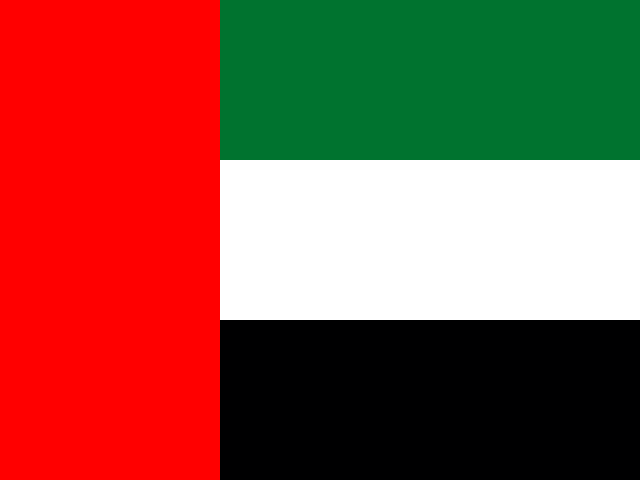
UAE52/100
“Two nations united by a shared refusal to let weather ruin a good time, divided by every conceivable method they've chosen to achieve it.”
Breakdown & sources
Work-Life Balance55
Ireland drops everything for a sunny Tuesday afternoon; the UAE has legally mandated that certain hours of the day are too lethal for productivity — both, in their own way, have negotiated a truce with the outdoors.
Hierarchy & Formality48
The articles don't dwell on office politics, but a culture that engineers entire cities to eliminate discomfort and one that calls catastrophic weather 'grand' are operating from fundamentally different tolerances for what constitutes a problem worth escalating.
Communication Style50
The Irish have a rich vocabulary for resigned contentment in miserable conditions; the UAE has simply removed the miserable conditions — both approaches technically count as coping, though only one involves understatement.
Punctuality Culture58
Ireland cancels nothing for weather and the UAE schedules everything around it — a surface contradiction that, on reflection, produces two populations who arrive when they said they would, just for entirely different meteorological reasons.
Social Bonding54
The Irish bond outdoors in spite of the weather; Emiratis and expats bond indoors in malls chilled to Nordic settings — the conviviality is real in both cases, but one involves a pint and a rainbow and the other involves remembering where you parked in the shade.
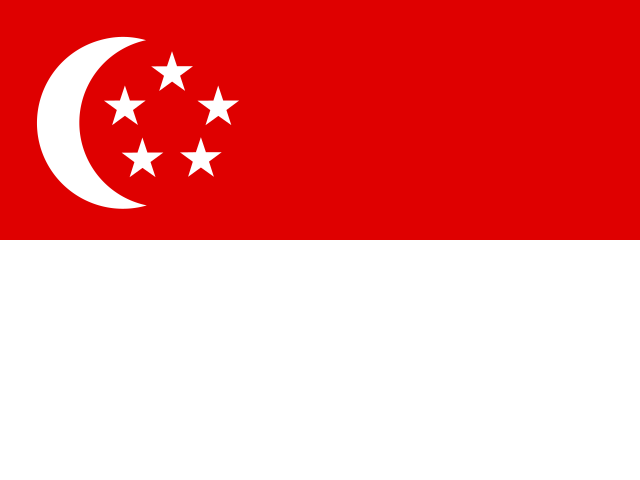
Singapore52/100
“Two islands that both claim to love the outdoors, provided one has planned the shrubbery eighteen months in advance and the other has checked that the rain has held off for at least four minutes.”
Breakdown & sources
Work-Life Balance45
Singapore engineers its leisure with the same project-management rigour it applies to orchid placement; Ireland treats free time as a meteorological improvisation, which produces either a perfect evening or a soggy disaster, and considers both outcomes equally grand.
Hierarchy & Formality48
A city-state where even the otters have a recognised social order meets a country where the highest authority at any outdoor gathering is whoever brought the cans — compatibility is possible, but the org chart will require negotiation.
Communication Style55
Singapore posts the rules clearly on laminated signs; Ireland communicates through studied understatement and the phrase 'sure it'll be grand,' which functions simultaneously as weather forecast, project plan, and binding legal agreement.
Punctuality Culture44
Singapore's Supertrees light up on schedule, the park connectors are mapped to the centimetre, and the monkeys escalate punctually; Ireland's entire outdoor calendar is contingent on a twenty-minute window of sunshine that may or may not materialise before February.
Social Bonding68
Both cultures find their deepest communion outdoors — one in a government-curated garden at dawn beside tai chi uncles, the other in a public park at the first hint of April warmth with a can of something cold — which is, allowing for latitude, essentially the same ritual.
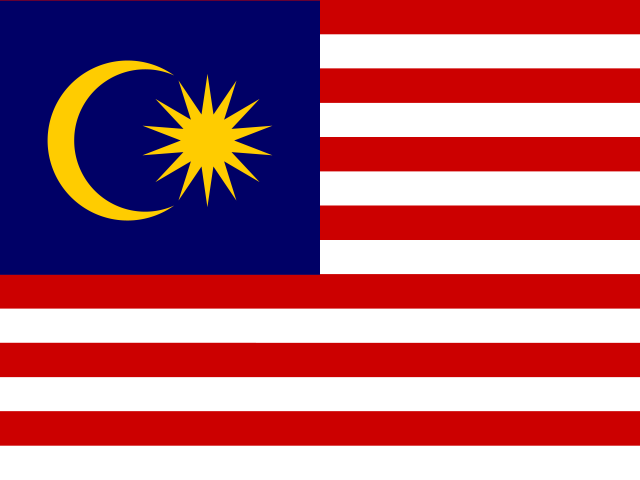
Malaysia48/100
“Two countries that agree healthcare matters and disagree entirely on what to do about it — a pairing that functions adequately on the surface until someone pulls a muscle on a Friday afternoon.”
Breakdown & sources
Work-Life Balance52
Both cultures nominally value time off, though Ireland's A&E waiting rooms suggest the system has quietly decided your personal time is negotiable.
Hierarchy & Formality50
Insufficient data from the articles to declare a winner, which is itself a kind of compatibility — two countries united by the shared mystery of their own office dynamics.
Communication Style55
Malaysia's bilingual doctors who fluently code-switch between English and Malay would find Ireland's monolingual paperwork trail a charmingly inefficient novelty.
Punctuality Culture30
Malaysia gets you seen within twenty minutes of walking in off the street; Ireland will see you sometime before the paperback runs out — a gap measured less in minutes than in philosophy.
Social Bonding53
One culture bonds over rounds of drinks expensive enough to fund a Malaysian GP consultation; the other bonds over the quiet satisfaction of having actually seen a doctor this decade.

Indonesia48/100
“A parish hurler and a Canggu yogi could, in theory, share a planet — and do, technically, though one is performing community and the other is performing wellness, and neither is entirely sure what the other is photographing.”
Breakdown & sources
Work-Life Balance52
Both cultures nominally endorse the idea of life outside the office, though Ireland achieves it through mud and collective suffering on a pitch, while Indonesia packages it in a linen co-ord and calls it a lifestyle.
Hierarchy & Formality45
Ireland's club coach screams at you with familial intimacy regardless of rank; Indonesia's wellness economy has a strict unspoken hierarchy in which your Instagram following determines your place on the mat.
Communication Style44
The Irish communicate through physical endurance and post-match slagging; Indonesians in the wellness orbit communicate through curated imagery and sincere captions, which are not, strictly speaking, the same language.
Punctuality Culture50
Ireland's GAA training runs on local-knowledge time — late if the cows needed moving — while Bali's sunrise yoga begins precisely when the light is most flattering, which is its own kind of discipline.
Social Bonding38
Ireland bonds over generations of shared rivalry and post-match Guinness; Indonesia bonds over a shared aesthetic and the mutual understanding that everyone in this studio is being photographed and no one will admit it.
Turkey48/100
“A nation that apologises to furniture meets a nation that offers unsolicited life advice to strangers — between them, every conceivable social norm is being violated by someone.”
Breakdown & sources
Work-Life Balance52
Both cultures prize the social over the strictly professional, though one expresses this through loud collective warmth and the other through passive resistance to any meeting scheduled after 5pm.
Hierarchy & Formality55
Turkey's visible deference to elders and shopkeeper greetings finds a distant cousin in Ireland's politeness codes, though Irish informality tends to flatten hierarchies that Turkish culture prefers to acknowledge.
Communication Style28
Turkey shares your salary before the tea arrives; Ireland buries a mild concern under three qualifications, a self-deprecating joke, and the word 'grand' — these are not the same language.
Punctuality Culture58
Neither country has elevated timekeeping to a moral virtue, which is, diplomatically, a point of genuine alignment.
Social Bonding54
Both cultures are, beneath the surface, deeply hospitable — the Turk will press tea upon you until refusal becomes a diplomatic incident, and the Irish will buy you a round before you've learned their name, so long as you pretend you don't actually want it.

Oman47/100
“Two nations united by a single shared principle — that weather is simply something that happens to you — but divided on whether the correct response is to rebuild society around it or to pretend, with some dignity, that it isn't happening.”
Breakdown & sources
Work-Life Balance45
Oman front-loads its entire working day around a sun that is trying to kill you; Ireland maintains its schedule in quiet defiance of a sky that is merely being disagreeable.
Hierarchy & Formality50
The articles decline to weigh in, which is itself a kind of diplomatic neutrality both cultures might, for entirely different reasons, appreciate.
Communication Style55
Ireland has elevated weather complaint into a social ritual with its own etiquette and entry requirements; Oman has rendered the same subject a matter of engineering rather than conversation.
Punctuality Culture48
In Oman, punctuality is a function of solar position; in Ireland, it is a function of whether the rain jacket was findable — both systems are, technically, contingent.
Social Bonding42
The Irish bond over shared meteorological suffering with the warm exclusivity of a support group; Omani social life simply migrates wholesale to the hours when survival is plausible.
South Korea38/100
“Two nations that have both solved the problem of community belonging and arrived at solutions so different they would not recognise each other's answer as an answer.”
Breakdown & sources
Work-Life Balance42
Ireland decompresses horizontally at a pub with no fixed agenda; South Korea decompresses vertically inside a fortress of shared obligations — both involve community, neither involves rest.
Hierarchy & Formality30
Ireland's social order is negotiated over pints in real time, while South Korea's is encoded in apartment tenure and resident-association group chats, leaving the Irish expat perpetually unsure who they've accidentally offended.
Communication Style35
The Irish deploy deadpan affection disguised as mild insult; South Koreans enforce corridor etiquette through quiet, pointed social pressure — both are indirect, but in dialects with no shared vocabulary.
Punctuality Culture50
Ireland runs on the elastic schedule of whoever is still at the bar, while South Korea enforces noise curfews with the precision of a building bylaw — a wash, in the sense that neither will make the other comfortable.
Social Bonding33
One culture asks you to simply show up repeatedly at a pub until belonging accumulates; the other asks you to memorise the recycling rota and respect the hierarchy of long-term residents — both work, neither translates.