← Compatibility Index
 Finland
Ranked against every country we've compared Finland to, highest compatibility first.
New Zealand72/100
“Two nations that take their holidays extremely seriously and their small talk extremely reluctantly — a pairing that would work beautifully, provided nobody schedules anything for late June.”
Breakdown & sources
Work-Life Balance78
Finland achieves work-life balance by simply ceasing to exist professionally for a fortnight each June; New Zealand achieves it by arguing about the calendar long enough that everyone forgets they were supposed to be working.
Hierarchy & Formality70
Both countries wear their egalitarianism like a badge, though Finland expresses it through silence at a lake and New Zealand through a Waitangi debate conducted with improbable civility.
Communication Style68
Finns communicate by not communicating; New Zealanders communicate earnestly and at length about whether communication itself has been historically equitable — both arrive at roughly the same number of words.
Punctuality Culture74
Finland closes with the precision of a Swiss watch the moment Midsummer arrives, while New Zealand has legislated 'Mondayisation' specifically to ensure that imprecision about holidays is administratively impossible.
Social Bonding71
Being swatted with birch branches by a stranger named Pekka and being gently corrected about Anniversary Day by a Wellingtonian are, functionally, the same ritual of belonging — just with different humidity levels.
Australia62/100
“Two nations united by the conviction that nature is actively trying to kill them, separated only by whether the murder weapon is light or its complete absence.”
Breakdown & sources
Work-Life Balance68
Both cultures have quietly built entire philosophical frameworks around surviving their environment, which suggests a shared instinct to treat life as something other than a productivity metric.
Hierarchy & Formality65
The articles do not report on office hierarchies, which, in the case of Finland at least, is probably because everyone is in the sauna and titles feel awkward when you are all undressed.
Communication Style58
Australians discuss existential environmental threats with the breezy cheer of a pub quiz answer, while Finns process the same magnitude of peril through silence and steam — compatible goals, incompatible packaging.
Punctuality Culture60
When the sun rises for only a few hours or a mild Melbourne morning can detonate into four seasons by noon, punctuality becomes less a virtue and more an optimistic working hypothesis.
Social Bonding61
Australians bond at the beach between the flags; Finns bond in a sauna at 80°C — both rituals involve a degree of physical suffering voluntarily embraced in companionable silence, which is close enough.
USA38/100
“Two nations united by democracy and divided by everything that happens between people who share a room.”
Breakdown & sources
Work-Life Balance45
One country invented the concept of being 'on' at all times; the other invented legally mandated silence as a national pastime.
Hierarchy & Formality55
Both cultures trend flat and informal, though Americans perform friendliness to get there while Finns simply skip the performance entirely.
Communication Style18
The American operating system requires constant narration; the Finnish one treats narration as a system error.
Punctuality Culture60
A rare truce: both nations consider being late a minor moral failing, even if they disagree on whether to mention it.
Social Bonding22
Americans bond instantly and shallowly; Finns bond never and then permanently — these are not compatible firmware versions.
Japan38/100
“Two nations that have independently optimised for not talking to strangers arrive at this relationship with incompatible reasons for the silence.”
Breakdown & sources
Work-Life Balance35
Japan engineers an entire national calendar around communal celebration; Finland engineers an entire population's disappearance into the forest — both are serious commitments, just to irreconcilable visions of what 'off' means.
Hierarchy & Formality45
Japan's formality is elaborate, layered, and performed with choreographic precision; Finland's is largely absent, which is itself a kind of rigidity that Japan will find quietly baffling.
Communication Style28
Finland speaks perfect English and declines to use it unnecessarily; Japan speaks minimal English and will chase you down three blocks to compensate — two countries that have arrived at reticence from entirely opposite directions and will not easily explain themselves to each other.
Punctuality Culture62
Both nations take time seriously enough that this is the one dimension where a shared neurosis quietly bonds them.
Social Bonding30
Japan bonds through dense, lantern-lit crowds of strangers chanting in unison; Finland bonds by inviting four people to a lake and not speaking for most of the weekend — a Venn diagram whose circles do not touch.
Singapore38/100
“Two countries that have each solved the problem of an uninhabitable climate with maximum ingenuity and zero transferable skills.”
Breakdown & sources
Work-Life Balance35
Finland resolves work-life tension by periodically sitting naked with colleagues in dangerous heat; Singapore resolves it by constructing an entire indoor civilization that makes leaving the office architecturally optional.
Hierarchy & Formality45
The articles are silent on org charts, which is itself informative: one culture is busy democratizing nudity in wooden boxes, and the other is engineering underground pedestrian infrastructure — both pursuits that suggest different relationships with authority entirely.
Communication Style42
Finland communicates through ritual embrace of shared discomfort; Singapore communicates through shared, unspoken agreement to architecturally avoid discomfort — both are indirect, but in directions so opposite they risk mutual bafflement.
Punctuality Culture50
Neither country's climate particularly rewards lingering outdoors between appointments, which is perhaps the only scheduling philosophy they genuinely share.
Social Bonding28
The Finn's idea of deepening a relationship is a naked sauna followed by a snow roll; the Singaporean's is a climate-controlled food court — both are sincere invitations, and neither visitor will be remotely prepared for the other's.

Kenya34/100
“A nation that considers sitting next to a stranger an act of aggression has been paired with one that will invite that stranger to a family wedding before the bus arrives — the compatibility here is, to put it diplomatically, theoretical.”
Breakdown & sources
Work-Life Balance45
Both cultures ultimately protect their downtime, though Finland does so through disciplined silence and vitamin D supplements, while Kenya does so by simply refusing to let a rainstorm be anyone's problem but the road's.
Hierarchy & Formality42
Kenya's system of respectful address — 'mzee,' 'mama,' left hand extended — signals a rich formal courtesy that Finland, a country that considers small talk an imposition, will find bewilderingly elaborate.
Communication Style12
One culture treats unprompted conversation as a form of assault; the other treats silence in a group as a personal affront — a pairing so perfectly opposed it could have been designed by a researcher studying discomfort.
Punctuality Culture38
Finland queues with military precision even when alone; Kenya officially advises against scheduling anything after 3pm during the long rains, on the reasonable grounds that Uhuru Highway may have become a river by then.
Social Bonding18
Kenyans bond through warm extended handshakes, matatu conversations, and invitations issued to near-strangers; Finns bond through shared silence, and would prefer you didn't mention it.
Chile34/100
“Two countries that have perfected the weekend in mutually exclusive ways: one insists you cannot possibly be well unless surrounded by relatives and choripán, the other insists you cannot possibly be well unless alone in a forest, and both are too committed to their respective therapies to consider a second opinion.”
Breakdown & sources
Work-Life Balance42
Both cultures guard the weekend with fierce ideological conviction — Chile just guards it with twelve family members and a grill, while Finland guards it with a lake and a formally scheduled absence from humanity.
Hierarchy & Formality38
The asador's authority over his grill is not negotiable, which is perhaps the only form of unquestioned hierarchy Finland — a country where silence outranks small talk — would find genuinely bewildering.
Communication Style18
Chile considers a four-hour conversation the minimum viable social interaction; Finland considers a comfortable silence its highest form of intimacy, meaning these two would spend a weekend together in a state of mutual, polite, irreconcilable distress.
Punctuality Culture45
Neither culture appears to be in any particular hurry — Chile because the asado ends when the last uncle decides it ends, and Finland because the mökki will still be there, silent and lakeside, whenever you arrive.
Social Bonding22
Chile bonds through enforced collective feasting and the implicit threat of a family text message; Finland bonds through shared nudity and the implicit threat of comfortable silence — two rituals that are, structurally, everything the other culture has specifically opted out of.
Dominican Republic34/100
“Two nations that have perfected the art of enduring miserable conditions, but whose methods — one involving rum and a domino table, the other involving a lamp and heroic silence — are so philosophically incompatible that any joint office retreat would end in mutual bafflement before the first agenda item.”
Breakdown & sources
Work-Life Balance38
One culture treats a blackout as an invitation to party; the other treats the absence of sunlight as a solemn personal challenge — both improvise, but in directions that would confuse the other deeply.
Hierarchy & Formality40
The articles don't dwell on org charts, but a culture that throws impromptu street parties during hurricanes and a culture of stoic vitamin D supplementation are not obviously producing the same PowerPoint decks.
Communication Style28
Dominican spiritual acceptance expressed loudly over dominoes and Finnish kaamos processed in alarming quiet are both valid coping strategies, provided neither party expects the other to participate.
Punctuality Culture35
When your calendar is organised around hurricane warnings on one side and the sun's complete dereliction of duty on the other, 'meeting at three' is more of a working hypothesis than a commitment.
Social Bonding42
Sauna culture and impromptu blackout street parties are, structurally, the same idea — forced proximity, minimal clothing, altered states — and yet the Finn emerging from steam in meditative silence and the Dominican neighbour arriving with a generator and a playlist would regard each other as alien life forms.
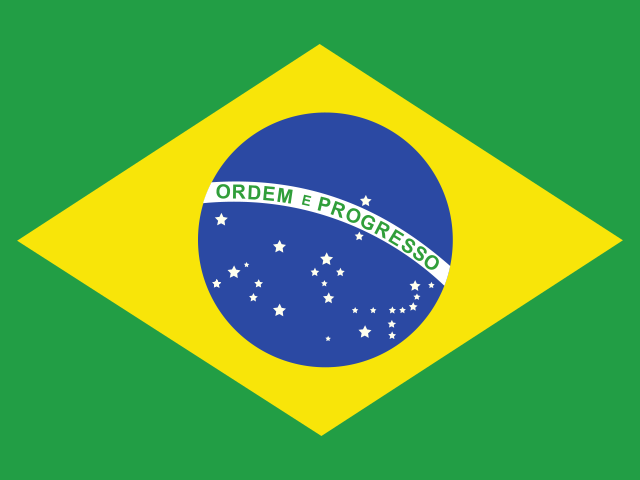
Brazil34/100
“A country that treats the bus schedule as a loose suggestion meets a country that has fined people for being ninety seconds late, and neither is entirely sure the other is serious.”
Breakdown & sources
Work-Life Balance42
Brazil integrates life into work hours with cheerful informality; Finland integrates work into a fortress of structured solitude — both outcomes involve suffering, but only one of them has açaí at the end.
Hierarchy & Formality38
Brazil's social warmth collapses professional distance on contact, while Finland has weaponised restraint into an ambient formality that requires no titles because the silence does the work.
Communication Style22
One culture treats every bus ride as a social occasion and considers quiet an insult; the other has enshrined silence as a transit design feature and a moral position.
Punctuality Culture18
Brazil builds buffer time into its social contract as a structural kindness; Finland issues fines for tardiness and has engineered trams to run on schedule through blizzards, which is either admirable or a threat.
Social Bonding44
Brazilians bond through beach volleyball, collective noise, and an invitation culture that is impossible to refuse gracefully; Finns bond through naked silence in a 90°C box, which is also, technically, impossible to refuse gracefully.
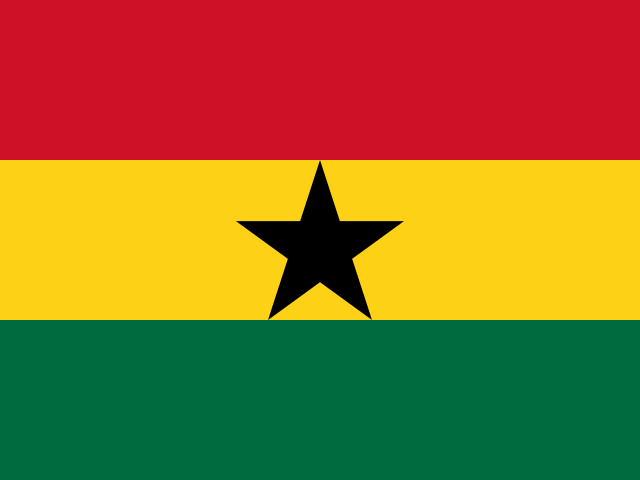
Ghana31/100
“A country that has engineered human contact out of commerce meets a country that considers commerce a form of human contact — compatibility is theoretically possible, but only if nobody speaks first.”
Breakdown & sources
Work-Life Balance42
Both cultures take their leisure seriously, though one recuperates in silence by a frozen lake and the other recuperates loudly at a market stall until sundown.
Hierarchy & Formality38
Ghana's formality is warm, relational, and performed through extended pleasantries; Finland's is cold, flat, and performed through the absence of any pleasantries whatsoever.
Communication Style14
One culture treats a transaction as an opportunity for theatre, biography, and light matchmaking; the other has replaced the cashier with a machine and considers this an improvement.
Punctuality Culture45
Finland's transactions are engineered to take no time at all, while Ghana's are engineered to take exactly as long as the relationship requires — which is longer.
Social Bonding22
In Ghana, bonding is the prerequisite for doing business; in Finland, the self-checkout machine was the friendliest interaction of the day, and no one found that troubling.
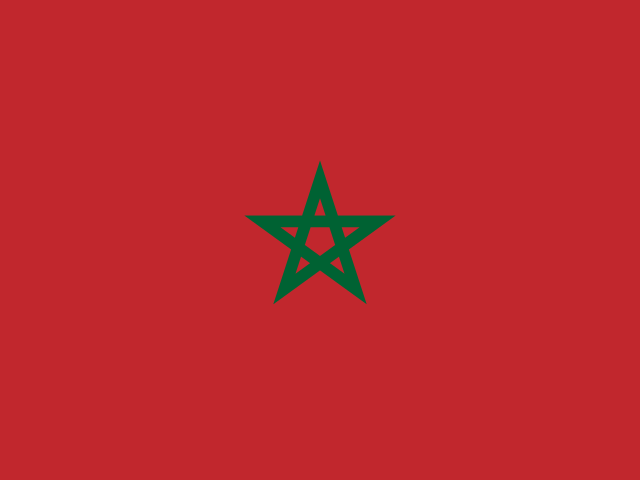
Morocco31/100
“A culture that courts through community consensus meets a culture that courts through prolonged silence — both deeply sincere, both utterly baffled by the other's method.”
Breakdown & sources
Work-Life Balance38
Morocco's unhurried café-culture pace and Finland's disciplined quietude both resist overwork in principle, but one does it through communal ritual and the other through constitutional introversion — compatible in outcome, alien in execution.
Hierarchy & Formality28
Morocco's family-and-community architecture of social approval runs on visible deference and relational hierarchy, while Finland's flat, egalitarian instincts treat unsolicited opinions from one's extended family as a minor social crisis.
Communication Style18
Morocco approaches connection through long, unhurried, expressive conversation over mint tea; Finland approaches connection through long, unhurried, expressive silence in a sauna — technically, both involve steam, but the resemblance ends there.
Punctuality Culture42
Neither culture appears to be racing anywhere, though Morocco's elastic social time is governed by relational rhythm and Finland's deliberateness is governed by a near-religious respect for not wasting anyone's patience.
Social Bonding22
Morocco bonds through networks — family, community, reputation, and the implicit audience of everyone who knows everyone — while Finland bonds through earned trust delivered in carefully rationed words and a sauna invitation that carries the emotional weight of a marriage proposal.
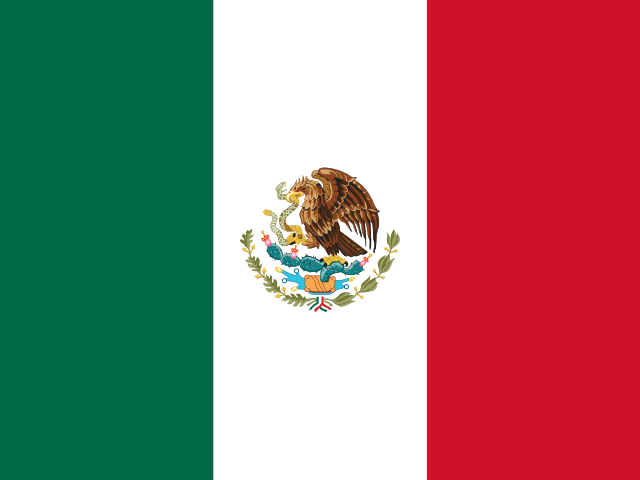
Mexico31/100
“Two nations that have both independently solved the queue, but whose solutions suggest they have never once agreed on anything else.”
Breakdown & sources
Work-Life Balance45
Insufficient data to rule definitively, though one country treats silence as leisure and the other treats a crowd as one.
Hierarchy & Formality35
Finland dispenses with warmth as a social lubricant entirely; Mexico considers its absence a mild personal insult.
Communication Style14
One culture has elevated the unsaid to an art form; the other considers a quiet room a problem requiring immediate correction.
Punctuality Culture40
Finns arrive at the bus stop two minutes early and stand in silence; Mexicans arrive when the crowd assembles, which is roughly the same thing by different mathematics.
Social Bonding18
Asking a stranger '¿quién es el último?' is Mexican small talk; in Finland, it would be considered an act of mild aggression.
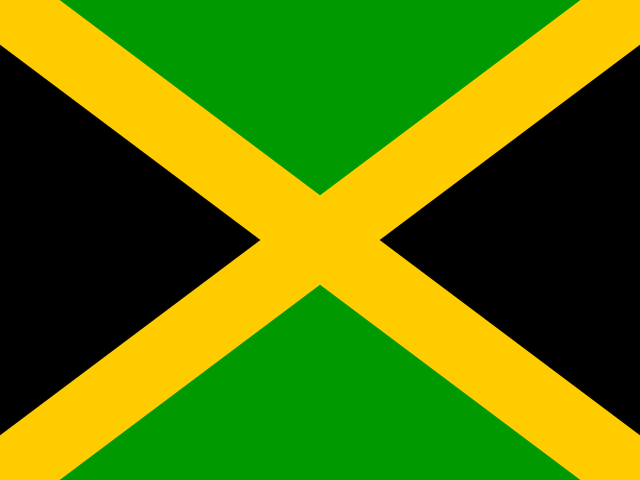
Jamaica28/100
“Two nations that have independently perfected the art of the ideal weekend, and would each consider the other's version a cry for help.”
Breakdown & sources
Work-Life Balance35
Both cultures guard their leisure with fierce conviction; the disagreement is merely whether that leisure should involve a sound system audible from three parishes away or a lake so quiet you can hear your own thoughts apologising for interrupting.
Hierarchy & Formality42
Jamaica's communal warmth and Finland's egalitarian bluntness both resist stuffiness, but they arrive at informality via such different routes — one through collective exuberance, one through deliberate minimalism — that the destination barely resembles itself.
Communication Style18
A Jamaican who interprets silence as a social malfunction and a Finn who interprets small talk as a personal affront are, technically, having a conversation — in the same way that a sound system and a mökki are both forms of audio equipment.
Punctuality Culture22
'Soon come' and the rigidly pre-scheduled Finnish weekend exist at opposite ends of the temporal imagination, and no amount of goodwill will convince either party that the other's relationship with time is not, at some level, a provocation.
Social Bonding20
Bonding in Jamaica requires a crowd, a bass line, and at least one plan that changes mid-execution; bonding in Finland requires a sauna, silence, and the mutual understanding that you are not expected to say anything meaningful until approximately the third beer.