← Compatibility Index
 Indonesia
Ranked against every country we've compared Indonesia to, highest compatibility first.

Spain54/100
“Two nations that have independently mastered the art of doing nothing in particular, but disagree profoundly on whether that requires paperwork.”
Breakdown & sources
Work-Life Balance68
Both cultures treat leisure as a serious civic obligation, though Indonesia outsources the guilt to a housekeeper who has already folded your towel into a swan while you slept.
Hierarchy & Formality45
Spain codifies its hierarchies in triplicate and files them with the municipal tourist authority; Indonesia embeds them in a spiritual offering you must not step on — different paperwork, same basic message.
Communication Style60
Indonesian staff anticipate your needs before you articulate them; Spanish booking terms articulate consequences before you've made a mistake — both are communicating, just in opposite directions.
Punctuality Culture42
Indonesia's relaxed approach to front-desk hours and Spain's siesta-hour service gaps suggest a shared indifference to clock-watching, undermined entirely by Spain's strictly enforced cancellation policies.
Social Bonding55
The Indonesian warm greeting and the Spanish heritage parador both invite you to feel at home, provided you have registered your ID, respected the offerings, and tipped accordingly.

Ireland48/100
“A parish hurler and a Canggu yogi could, in theory, share a planet — and do, technically, though one is performing community and the other is performing wellness, and neither is entirely sure what the other is photographing.”
Breakdown & sources
Work-Life Balance52
Both cultures nominally endorse the idea of life outside the office, though Ireland achieves it through mud and collective suffering on a pitch, while Indonesia packages it in a linen co-ord and calls it a lifestyle.
Hierarchy & Formality45
Ireland's club coach screams at you with familial intimacy regardless of rank; Indonesia's wellness economy has a strict unspoken hierarchy in which your Instagram following determines your place on the mat.
Communication Style44
The Irish communicate through physical endurance and post-match slagging; Indonesians in the wellness orbit communicate through curated imagery and sincere captions, which are not, strictly speaking, the same language.
Punctuality Culture50
Ireland's GAA training runs on local-knowledge time — late if the cows needed moving — while Bali's sunrise yoga begins precisely when the light is most flattering, which is its own kind of discipline.
Social Bonding38
Ireland bonds over generations of shared rivalry and post-match Guinness; Indonesia bonds over a shared aesthetic and the mutual understanding that everyone in this studio is being photographed and no one will admit it.
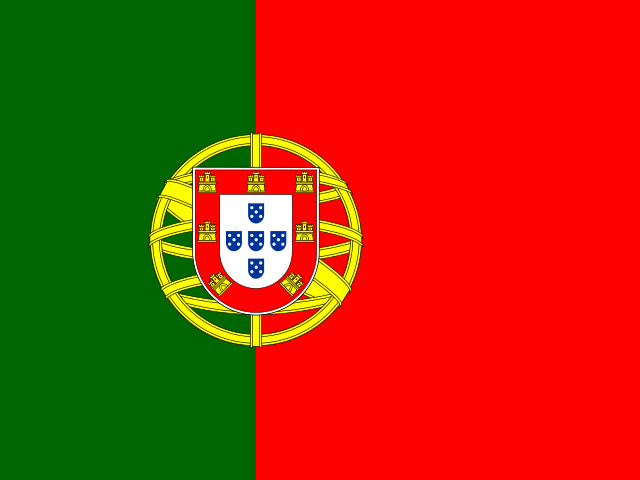
Portugal47/100
“A pairing in which one side shows up at 9pm with wine and no agenda, and the other has already texted your mother.”
Breakdown & sources
Work-Life Balance55
Both nations resist the Protestant work-ethic sprint, though Indonesia's family obligations mean leisure time is never truly off the clock.
Hierarchy & Formality38
Portugal's casual informality and Indonesia's structured deference to family and tradition occupy meaningfully different rungs of the same ladder.
Communication Style42
Portugal deploys playful verbal teasing as intimacy; Indonesia deploys polite formality as respect — both are sophisticated systems, neither translates cleanly.
Punctuality Culture62
A rare point of solidarity: neither country has issued a formal apology for arriving late, and neither intends to start.
Social Bonding36
Portugal bonds over unplanned rooftop conversations at midnight; Indonesia bonds over structured family introductions with implicit timelines — both are warm, neither is the same warmth.

Canada38/100
“A pairing in which one country considers a selfie sufficient proof of personhood and the other considers it an insult to the stamping gods.”
Breakdown & sources
Work-Life Balance45
Both countries eventually get things done; they simply disagree on whether 'eventually' means an app notification or a third branch visit.
Hierarchy & Formality30
Indonesia's layered, relationship-dependent formality and Canada's cheerful, unhurried egalitarianism are philosophically adjacent only in that both involve waiting.
Communication Style42
Canadians communicate digitally and immediately; Indonesians communicate in person, patiently, and with a stamp to confirm it happened.
Punctuality Culture35
Canada's 'friendly but unhurried' service culture and Indonesia's 'bring a book, you'll likely be back' ethos reach the same destination by entirely different routes.
Social Bonding52
Indonesia bonds through cultivated personal relationships with specific branch staff; Canada bonds through the collective trauma of building credit from zero.

Netherlands34/100
“A nation that has philosophically accepted that time is a suggestion meets a nation that has weaponised punctuality and attached it to a bicycle bell — the resulting collision is, fittingly, a traffic incident.”
Breakdown & sources
Work-Life Balance38
Indonesians spend their leisure time sitting in traffic contemplating leisure, while the Dutch aggressively cycle home at 5pm sharp — both are suffering, just on different schedules.
Hierarchy & Formality30
One culture has refined the art of deferential patience through ninety-minute gridlock; the other will ring a bell at a senior colleague and feel entirely justified.
Communication Style28
The Dutch deliver feedback with the directness of a tram that does not yield to physics, while Indonesians have perfected the art of the warm, non-committal reply — these are not compatible operating systems.
Punctuality Culture18
Jakarta treats an ETA as a opening bid in a negotiation with rainfall, while Amsterdam treats a two-minute delay as a personal moral failing — a pairing that will satisfy no one and enrage at least one party.
Social Bonding52
Both cultures have developed rich survival rituals around their commutes — Indonesians bond over shared Gojek horror stories, the Dutch over stolen bicycle eulogies — and this, at least, is common ground.